


Page 307 - American Stories, A History of the United States
P. 307
protecting the home. The drinking habits of the poor or laboring classes also aroused
            12.1                                concern. Particularly in urban areas, “respectable” and propertied people lived in fear
                                                that drunken mobs would attack private property and create chaos.
                                                    Many evangelical reformers regarded intemperance as the greatest obstacle to a
            12.2                                republic of God-fearing, self-disciplined citizens. In 1826, clergymen active in mission
                                                work organized the American Temperance Society to coordinate and extend the work
                                                local churches and moral reform societies had begun. The original aim was to encour-

            12.3                                age abstinence from “ardent spirits” or hard liquor; there was no agreement on the
                                                evils of beer and wine. The society sent out lecturers, issued a flood of literature, and
                                                sponsored essay contests. Its agents organized revival meetings and called on attendees
                                                to pledge to abstain from spirits. The campaign was effective. By 1834, its 5000 local
                                                branches had more than a million members, many of them women.
                                                    Some workingmen defiantly insisted on their right to drink, and built their own
                                                autonomous social life in grog halls and taverns, with heavy drinking an important
                                                part of it. But others joined temperance societies of their own. The Washingtonian
                                                Society, born in 1840, sought out the confirmed drunkard and offered him salvation.
                                                The Washingtonians held weekly experience meetings to testify to their own struggles
                                                with “Demon Drink” and tried to recreate the enjoyable community aspects of tavern
                                                life with temperance songs, poems, and theatre. Washingtonian Societies spread like
                                                wildfire among young men, women, and children, including African Americans.
                  benevolent empire  Collection     Although it may be doubted whether many confirmed drunkards were cured, the
                  of missionary and reform societies
                  that sought to stamp out social   movement did alter the drinking habits of middle-class American males by making temper-
                  evils in American society in the   ance a mark of respectability. Per capita consumption of hard liquor declined more than 50
                  1820s and 1830s.              percent during the 1830s, and by 1850 it was down to one-third of what it had been in 1830.
                                                    Cooperating missionary and reform societies—collectively known as the
                                                  benevolent empire—were a major force in American culture by the early 1830s. Efforts
                     Quick Check                to modify American attitudes and institutions seemed to be bearing fruit. The middle
                     What was the temperance    class was embracing self-control and self-discipline, equipping individuals to confront
                       movement, and why did it attract so   a new world of economic growth and social mobility without losing their cultural and
                     many followers in this period?
                                                moral bearings.


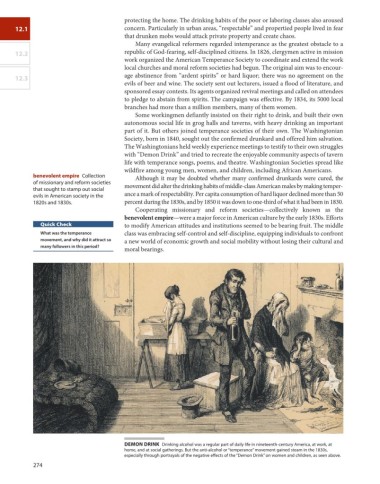
                                                DeMon DRink  Drinking alcohol was a regular part of daily life in nineteenth-century America, at work, at
                                                home, and at social gatherings. but the anti-alcohol or “temperance” movement gained steam in the 1830s,
                                                especially through portrayals of the negative effects of the “Demon Drink” on women and children, as seen above.
                  274

