


Page 326 - American Stories, A History of the United States
P. 326
13.1


                                                                                                                           13.2


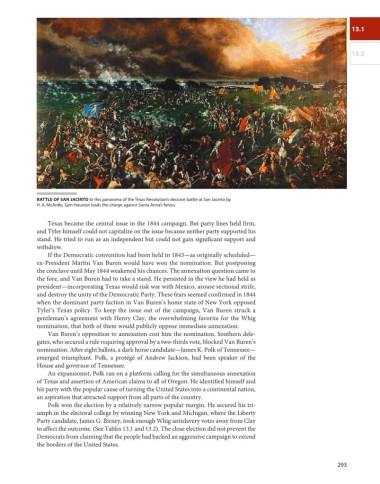
                    bAttle of SAn jAcinto in this panorama of the texas Revolution’s decisive battle at san jacinto by
                    H. A. McArdle, sam Houston leads the charge against santa Anna’s forces.

                       Texas became the central issue in the 1844 campaign. But party lines held firm,
                    and Tyler himself could not capitalize on the issue because neither party supported his
                    stand. He tried to run as an independent but could not gain significant support and
                    withdrew.
                       If the Democratic convention had been held in 1843—as originally scheduled—
                    ex-President Martin Van Buren would have won the nomination. But postponing
                    the conclave until May 1844 weakened his chances. The annexation question came to
                    the fore, and Van Buren had to take a stand. He persisted in the view he had held as
                    president—incorporating Texas would risk war with Mexico, arouse  sectional strife,
                    and destroy the unity of the Democratic Party. These fears seemed confirmed in 1844
                    when the dominant party faction in Van Buren’s home state of New York opposed
                    Tyler’s Texas policy. To keep the issue out of the campaign, Van Buren struck a
                    gentleman’s agreement with Henry Clay, the overwhelming favorite for the Whig
                    nomination, that both of them would publicly oppose immediate annexation.
                       Van Buren’s opposition to annexation cost him the nomination. Southern dele-
                    gates, who secured a rule requiring approval by a two-thirds vote, blocked Van Buren’s
                    nomination. After eight ballots, a dark horse candidate—James K. Polk of  Tennessee—
                    emerged triumphant. Polk, a protégé of Andrew Jackson, had been speaker of the
                    House and governor of Tennessee.
                       An expansionist, Polk ran on a platform calling for the simultaneous annexation
                    of Texas and assertion of American claims to all of Oregon. He identified himself and
                    his party with the popular cause of turning the United States into a continental nation,
                    an aspiration that attracted support from all parts of the country.
                       Polk won the election by a relatively narrow popular margin. He secured his tri-
                    umph in the electoral college by winning New York and Michigan, where the Liberty
                    Party candidate, James G. Birney, took enough Whig antislavery votes away from Clay
                    to affect the outcome. (See Tables 13.1 and 13.2). The close election did not prevent the
                    Democrats from claiming that the people had backed an aggressive campaign to extend
                    the borders of the United States.


                                                                                                                       293

