


Page 323 - American Stories, A History of the United States
P. 323
facing a nation that was overreaching itself by indulging its pride and exalted sense of destiny
13.1 with too little concern for the moral and practical consequences.
The Young American ideal—the idea of a young country led by young men into new paths
of prosperity and greatness—appealed to many people and found support across party lines. but
13.2 it came to be identified primarily with young Democrats who wanted to move their party away
from its traditional fear of commerce and industry. Unlike oldline jeffersonians and jacksonians,
Young Americans had no qualms about the market economy and the speculative, materialistic
spirit it called forth.
before 1848, the Young American impulse focused mainly on the great expanse of western
lands that lay just beyond the nation’s borders. After the Mexican–American War, when territo
rial gains extended the nation’s boundaries from the Atlantic to the Pacific, attention shifted to
internal development. Discoveries of gold in the nation’s western territories fostered economic
growth, technological advances spurred industrialization, and increased immigration brought
more people to populate the lands newly acquired—by agreement or by force.
texas, Manifest Destiny, and the
Mexican–American War
13.1 Why did the United states annex texas and the southwest?
t he rush of settlers beyond the nation’s borders in the 1830s and 1840s
inspired politicians and propagandists to call for annexing those areas.
manifest destiny coined in 1845, Some proclaimed it was the Manifest Destiny of the United States to absorb
this term referred to a doctrine in all of North America, including Canada and Mexico. Such ambitions—and
support of territorial expansion the policies they inspired—led to a diplomatic confrontation with Britain over claims
based on the belief that the
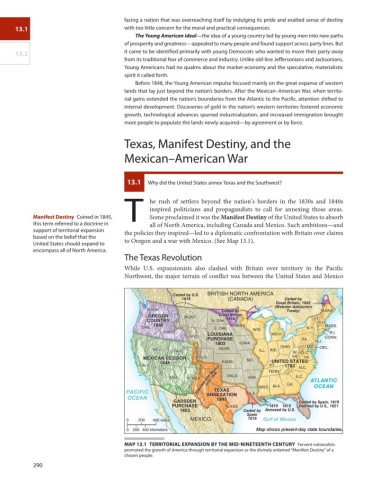
United states should expand to to Oregon and a war with Mexico. (See Map 13.1).
encompass all of North America.
the texas Revolution
While U.S. expansionists also clashed with Britain over territory in the Pacific
Northwest, the major terrain of conflict was between the United States and Mexico
Ceded by U.S. BRITISH NORTH AMERICA
1818 (CANADA) Ceded by
Great Britain, 1842
(Webster-Ashburton
WASH. Ceded by Treaty) MAINE
OREGON MONT. Great Britain
COUNTRY N. DAK. 1818 VT. N.H.
ORE. 1846 S. DAK. MINN. WIS. N.Y. MASS.
IDAHO MICH. R.I.
WYO. LOUISIANA CONN.
PURCHASE PA. N.J.
1803 IOWA
NEV. UTAH NEBR. ILL. IND. OHIO W. D.C. MD. DEL.
VA.
VA.
MEXICAN CESSION COLO. MO. UNITED STATES
CALIF. 1848 KANS. KY. 1783 N.C.
Disputed with Mexico GA. ATLANTIC
ARIZ. N. MEX. until 1848 OKLA. ARK. TENN. S.C.
TEXAS
PACIFIC ANNEXATION LA. MISS. ALA. OCEAN
OCEAN 1845 FLA.
GADSDEN Ceded by Spain, 1819
PURCHASE TEXAS 1810 1812 Ratified by U.S., 1821
1853 Ceded by Annexed by U.S.
Spain
0 200 400 miles MEXICO 1819 Gulf of Mexico
Map shows present-day state boundaries.
0 200 400 kilometers Map shows present-day state boundaries.
mAP 13.1 teRRitoRiAl exPAnSion bY tHe mid-nineteentH centURY Fervent nationalists
promoted the growth of America through territorial expansion as the divinely ordained “Manifest Destiny” of a
chosen people.
290

