


Page 319 - American Stories, A History of the United States
P. 319
On MyHistoryLab                                                           Study and Review on MyHistoryLab


                    Chapter Review                                       Timeline


                  The Rise of evangelicalism                                         1801
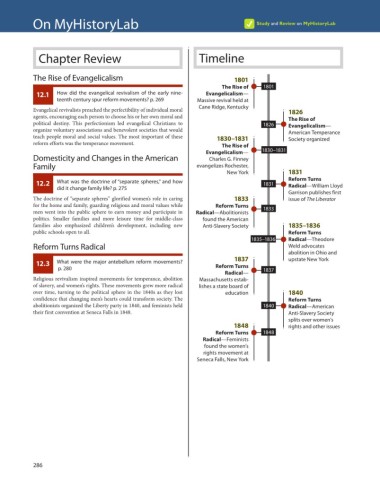
                                                                                The Rise of   1801
                     12.1    How did the evangelical revivalism of the early nine-  evangelicalism—
                          teenth century spur reform movements? p. 269  Massive revival held at
                                                                         Cane Ridge, Kentucky
                  Evangelical revivalists preached the perfectibility of individual moral             1826
                  agents, encouraging each person to choose his or her own moral and                  The Rise of
                  political destiny. This perfectionism led evangelical Christians to         1826    evangelicalism—
                  organize voluntary associations and benevolent societies that would                 American Temperance
                  teach people moral and social values. The most important of these   1830–1831       society organized
                  reform efforts was the temperance movement.                   The Rise of
                                                                           evangelicalism—    1830–1831
                  Domesticity and Changes in the American                   Charles G. Finney
                  Family                                                evangelizes Rochester,
                                                                                  New York            1831
                    12.2    What was the doctrine of “separate spheres,” and how              1831    Reform Turns
                                                                                                      Radical—William Lloyd
                          did it change family life? p. 275
                                                                                                      Garrison publishes first
                  The doctrine of “separate spheres” glorified women’s role in caring   1833          issue of The Liberator
                  for the home and family, guarding religious and moral values while   Reform Turns
                  men went into the public sphere to earn money and participate in   Radical—Abolitionists   1833
                  politics. Smaller families and more leisure time for middle-class   found the American
                  families also emphasized children’s development, including new   Anti-slavery society  1835–1836
                  public schools open to all.                                                         Reform Turns
                                                                                          1835–1836   Radical—Theodore
                  Reform Turns Radical                                                                Weld advocates
                                                                                                      abolition in Ohio and
                                                                                     1837             upstate New York
                    12.3    What were the major antebellum reform movements?   Reform Turns
                           p. 280                                                             1837
                                                                                 Radical—
                  Religious revivalism inspired movements for temperance, abolition   Massachusetts estab-
                  of slavery, and women’s rights. These movements grew more radical   lishes a state board of
                  over time, turning to the political sphere in the 1840s as they lost   education    1840
                  confidence that changing men’s hearts could transform society. The                  Reform Turns
                  abolitionists organized the Liberty party in 1840, and feminists held       1840    Radical—American
                  their first convention at Seneca Falls in 1848.                                     Anti-slavery society
                                                                                                      splits over women’s
                                                                                    1848              rights and other issues
                                                                              Reform Turns    1848
                                                                          Radical—Feminists
                                                                           found the women’s
                                                                          rights movement at
                                                                        seneca Falls, New York


                  286

