


Page 318 - American Stories, A History of the United States
P. 318
Read the Document    Lucretia Mott, Declaration of Sentiments and
                                                 resolutions (1848)                                                        12.1


                                                                                                                           12.2


                                                                                                                           12.3


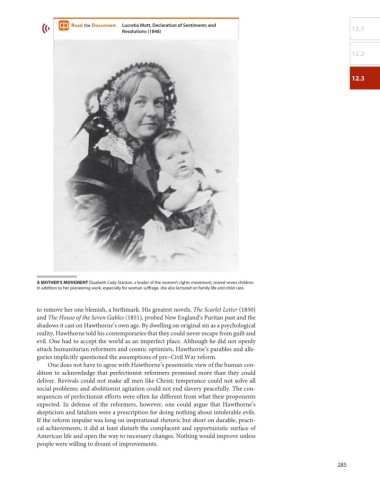
                    a MoTheR’S MoveMenT elizabeth Cady stanton, a leader of the women’s rights movement, reared seven children.
                    in addition to her pioneering work, especially for woman suffrage, she also lectured on family life and child care.


                    to remove her one blemish, a birthmark. His greatest novels, The Scarlet Letter (1850)
                    and The House of the Seven Gables (1851), probed New England’s Puritan past and the
                    shadows it cast on Hawthorne’s own age. By dwelling on original sin as a psychological
                    reality, Hawthorne told his contemporaries that they could never escape from guilt and
                    evil. One had to accept the world as an imperfect place. Although he did not openly
                    attack humanitarian reformers and cosmic optimists, Hawthorne’s parables and alle-
                    gories implicitly questioned the assumptions of pre–Civil War reform.
                       One does not have to agree with Hawthorne’s pessimistic view of the human con-
                    dition to acknowledge that perfectionist reformers promised more than they could
                    deliver. Revivals could not make all men like Christ; temperance could not solve all
                    social problems; and abolitionist agitation could not end slavery peacefully. The con-
                    sequences of perfectionist efforts were often far different from what their proponents
                    expected. In defense of the reformers, however, one could argue that Hawthorne’s
                    skepticism and fatalism were a prescription for doing nothing about intolerable evils.
                    If the reform impulse was long on inspirational rhetoric but short on durable, practi-
                    cal achievements, it did at least disturb the complacent and opportunistic surface of
                    American life and open the way to necessary changes. Nothing would improve unless
                    people were willing to dream of improvements.


                                                                                                                       285

