


Page 441 - Business Principles and Management
P. 441
Unit 5


                                                company has available to finance operations. The change in the price of a
                                                company’s stock is important to stockholders when they buy and sell the stock, so
                                                the company’s management wants to maximize the value of its stock to make
                                                the company attractive to investors. If a corporation wants to increase its capital,
                                                it must issue additional stock or keep profits for use in the company rather than
                                                using those profits to pay stockholder dividends.


                                                ISSUING STOCK
                                                If an existing corporation needs additional equity and decides to raise it through
                                                the sale of stock, that decision will need to be approved by the board of direc-
                                                tors. Common stockholders will have the first right to purchase the stock.
                                                Stockholders will be concerned about the effect of the sale of new stock on the
                                               PHOTO: © DIGITAL VISION.  price of their current shares. Having more shares of a company available usually
                                                results in a lower stock price.
                                                   Corporations must determine the kind of stock to issue. The certificate of incor-
                                                poration states whether all authorized stock is common stock or whether part is
                                                common and part preferred. Corporations cannot issue other stock unless they
                                                receive authorization from the state in which they are chartered.
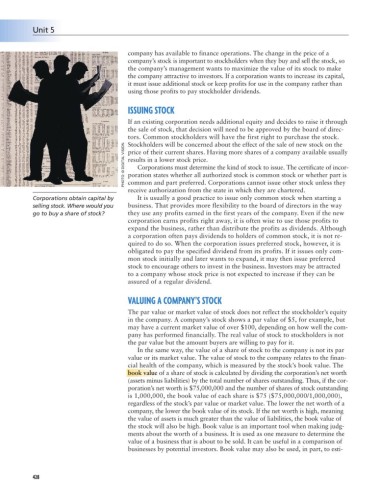
                  Corporations obtain capital by   It is usually a good practice to issue only common stock when starting a
                  selling stock. Where would you  business. That provides more flexibility to the board of directors in the way
                  go to buy a share of stock?   they use any profits earned in the first years of the company. Even if the new
                                                corporation earns profits right away, it is often wise to use those profits to
                                                expand the business, rather than distribute the profits as dividends. Although
                                                a corporation often pays dividends to holders of common stock, it is not re-
                                                quired to do so. When the corporation issues preferred stock, however, it is
                                                obligated to pay the specified dividend from its profits. If it issues only com-
                                                mon stock initially and later wants to expand, it may then issue preferred
                                                stock to encourage others to invest in the business. Investors may be attracted
                                                to a company whose stock price is not expected to increase if they can be
                                                assured of a regular dividend.

                                                VALUING A COMPANY’S STOCK

                                                The par value or market value of stock does not reflect the stockholder’s equity
                                                in the company. A company’s stock shows a par value of $5, for example, but
                                                may have a current market value of over $100, depending on how well the com-
                                                pany has performed financially. The real value of stock to stockholders is not
                                                the par value but the amount buyers are willing to pay for it.
                                                   In the same way, the value of a share of stock to the company is not its par
                                                value or its market value. The value of stock to the company relates to the finan-
                                                cial health of the company, which is measured by the stock’s book value. The
                                                book value of a share of stock is calculated by dividing the corporation’s net worth
                                                (assets minus liabilities) by the total number of shares outstanding. Thus, if the cor-
                                                poration’s net worth is $75,000,000 and the number of shares of stock outstanding
                                                is 1,000,000, the book value of each share is $75 ($75,000,000/1,000,000),
                                                regardless of the stock’s par value or market value. The lower the net worth of a
                                                company, the lower the book value of its stock. If the net worth is high, meaning
                                                the value of assets is much greater than the value of liabilities, the book value of
                                                the stock will also be high. Book value is an important tool when making judg-
                                                ments about the worth of a business. It is used as one measure to determine the
                                                value of a business that is about to be sold. It can be useful in a comparison of
                                                businesses by potential investors. Book value may also be used, in part, to esti-


                  428

