


Page 492 - Business Principles and Management
P. 492
Chapter 18 • Credit and Insurance


                        debit card, customers can also withdraw cash from their checking or savings
                        accounts through ATMs and pay bills by phone or computer. Usually the same
                        system, a card scanner, is used to process debit cards as credit cards. However,
                        with debit cards, customers may have to enter a personal identification number
                        (PIN) before the transaction can be processed.
                           A debit card saves retailers the trouble of sending sales slips to the bank, and
                        the bank doesn’t have to bill and collect from customers. The bank, however,
                        sends monthly summaries of transactions to retailers and customers. The bank
                        charges fees, of course, for debit card services.
                           The use of debit cards and credit cards reduces the amount of cash and the
                        number of checks handled in the economy. Customers benefit from debit cards
                        by not having to carry large amounts of cash or a checkbook. People who cannot
                        obtain credit cards may be able to carry a debit card because it reflects money
                        already deposited in a bank. A debit card is riskier than a credit card, however,
                        because the money transfer is immediate. There is less legal protection for con-
                        sumers using debit cards than for those using credit cards. With credit cards, cus-
                        tomers who pay their bill at the end of the month are actually receiving a “free”
                        loan of that money for a short time. Debit card charges are withdrawn immedi-
                        ately from the account, so no money is loaned.
                           Prepaid calling cards are a type of debit card. They have become very popu-
                        lar in an age of increased travel and fewer public pay telephones that accept
                        cash. Calling cards carry relatively low per-minute costs and can be replenished
                        online using a credit card or simply discarded when empty.
                           American Express and other companies sell prepaid debit cards that can be
                        used in place of traveler’s checks or as a ready source of funds for shoppers. Par-
                        ents may buy a card with a relatively small prepaid amount for their children to
                        use at summer camp, on school trips, or even in college. The card can be used to
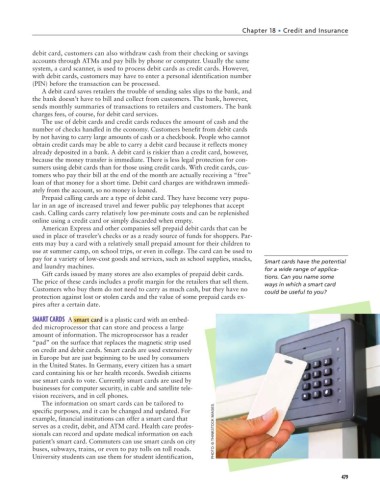
                        pay for a variety of low-cost goods and services, such as school supplies, snacks,  Smart cards have the potential
                        and laundry machines.                                                    for a wide range of applica-
                           Gift cards issued by many stores are also examples of prepaid debit cards.  tions. Can you name some
                        The price of these cards includes a profit margin for the retailers that sell them.  ways in which a smart card
                        Customers who buy them do not need to carry as much cash, but they have no  could be useful to you?
                        protection against lost or stolen cards and the value of some prepaid cards ex-
                        pires after a certain date.

                        SMART CARDS A smart card is a plastic card with an embed-
                        ded microprocessor that can store and process a large
                        amount of information. The microprocessor has a reader
                        “pad” on the surface that replaces the magnetic strip used
                        on credit and debit cards. Smart cards are used extensively
                        in Europe but are just beginning to be used by consumers
                        in the United States. In Germany, every citizen has a smart
                        card containing his or her health records. Swedish citizens
                        use smart cards to vote. Currently smart cards are used by
                        businesses for computer security, in cable and satellite tele-
                        vision receivers, and in cell phones.
                           The information on smart cards can be tailored to
                        specific purposes, and it can be changed and updated. For
                        example, financial institutions can offer a smart card that
                        serves as a credit, debit, and ATM card. Health care profes-
                        sionals can record and update medical information on each  PHOTO: © THINKSTOCK IMAGES.
                        patient’s smart card. Commuters can use smart cards on city
                        buses, subways, trains, or even to pay tolls on toll roads.
                        University students can use them for student identification,


                                                                                                                         479

