


Page 537 - Business Principles and Management
P. 537
Unit 6


                                                IMPROVING PRODUCTION PROCESSES
                                                Improving quality and productivity has been one of the most important chal-
                                                lenges facing businesses in the last decade. Increasing global competition has
                                                resulted in a larger number of products from which customers can choose.
                                                Businesses have found that customers buy the best product available for the
                                                price they can afford, resulting in increased pressure to improve quality while
                                                holding down costs and prices.
                                                   As you learned in Chapter 1, for many years companies were more interested
                                                in production efficiency than in quality. As early as the 1950s, Dr. W. Edwards
                                                Deming was encouraging businesses to focus on quality as the most important
                                                company goal, but his ideas were largely ignored in the United States. Today,
                                                however, because of the success of companies that have adopted Deming’s ideas,
                                                most manufacturers use principles of quality management. Quality management is
                                                the process of assuring product quality by developing standards for all operations
                                                and products and measuring results against those standards. For quality manage-
                                                ment to succeed, the company must believe that no defects are acceptable and that
                                                all employees are responsible for quality. Everyone must be able to identify prob-
                                                lems and take responsibility for correcting them. Rewards must be based on
                                                achieving the quality standards rather than meeting a certain level of production.
                                                   To encourage American companies to improve quality, Congress created the
                                                Malcolm Baldrige National Quality Award in 1987. To win the award, a com-
                                                pany must demonstrate that it has implemented a program to develop and main-
                                                tain quality in all of its products and activities. Companies compete for the award
                                                because customers are more likely to buy from companies that can prove their
                                                commitment to quality by winning this honor.
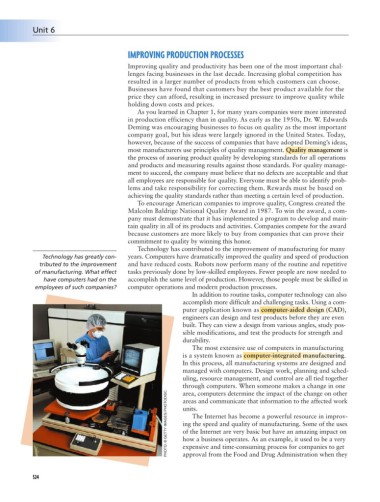
                                                   Technology has contributed to the improvement of manufacturing for many
                     Technology has greatly con-  years. Computers have dramatically improved the quality and speed of production
                    tributed to the improvement  and have reduced costs. Robots now perform many of the routine and repetitive
                  of manufacturing. What effect  tasks previously done by low-skilled employees. Fewer people are now needed to
                     have computers had on the  accomplish the same level of production. However, those people must be skilled in
                   employees of such companies?  computer operations and modern production processes.
                                                                    In addition to routine tasks, computer technology can also
                                                                 accomplish more difficult and challenging tasks. Using a com-
                                                                 puter application known as computer-aided design (CAD),
                                                                 engineers can design and test products before they are even
                                                                 built. They can view a design from various angles, study pos-
                                                                 sible modifications, and test the products for strength and
                                                                 durability.
                                                                    The most extensive use of computers in manufacturing
                                                                 is a system known as computer-integrated manufacturing.
                                                                 In this process, all manufacturing systems are designed and
                                                                 managed with computers. Design work, planning and sched-
                                                                 uling, resource management, and control are all tied together
                                                                 through computers. When someone makes a change in one
                                                            PHOTO: © GETTY IMAGES/PHOTODISC.  units.
                                                                 area, computers determine the impact of the change on other
                                                                 areas and communicate that information to the affected work
                                                                    The Internet has become a powerful resource in improv-
                                                                 ing the speed and quality of manufacturing. Some of the uses
                                                                 of the Internet are very basic but have an amazing impact on
                                                                 how a business operates. As an example, it used to be a very
                                                                 expensive and time-consuming process for companies to get


                  524                                            approval from the Food and Drug Administration when they

