


Page 588 - Business Principles and Management
P. 588
Chapter 21 • Product Development and Distribution


                        TRACKING PRODUCTS
                        An important part of product handling is keeping
                        track of the products. Businesses and customers
                        want to know where products are in the distribution
                        channel and when they will be delivered. The record
                        keeping required is often a very time-consuming task.
                        Businesses now use bar coding to track products dur-
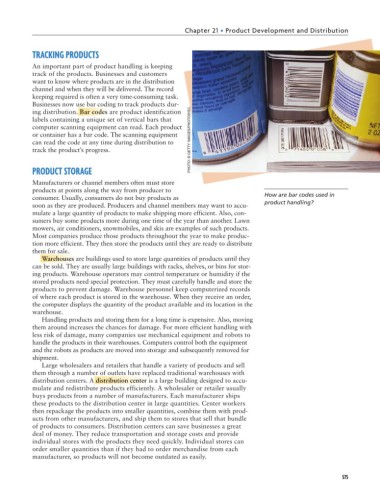
                        ing distribution. Bar codes are product identification
                        labels containing a unique set of vertical bars that
                        computer scanning equipment can read. Each product
                        or container has a bar code. The scanning equipment
                        can read the code at any time during distribution to  PHOTO: © GETTY IMAGES/PHOTODISC.
                        track the product’s progress.


                        PRODUCT STORAGE
                        Manufacturers or channel members often must store
                        products at points along the way from producer to
                                                                                                 How are bar codes used in
                        consumer. Usually, consumers do not buy products as
                                                                                                 product handling?
                        soon as they are produced. Producers and channel members may want to accu-
                        mulate a large quantity of products to make shipping more efficient. Also, con-
                        sumers buy some products more during one time of the year than another. Lawn
                        mowers, air conditioners, snowmobiles, and skis are examples of such products.
                        Most companies produce those products throughout the year to make produc-
                        tion more efficient. They then store the products until they are ready to distribute
                        them for sale.
                           Warehouses are buildings used to store large quantities of products until they
                        can be sold. They are usually large buildings with racks, shelves, or bins for stor-
                        ing products. Warehouse operators may control temperature or humidity if the
                        stored products need special protection. They must carefully handle and store the
                        products to prevent damage. Warehouse personnel keep computerized records
                        of where each product is stored in the warehouse. When they receive an order,
                        the computer displays the quantity of the product available and its location in the
                        warehouse.
                           Handling products and storing them for a long time is expensive. Also, moving
                        them around increases the chances for damage. For more efficient handling with
                        less risk of damage, many companies use mechanical equipment and robots to
                        handle the products in their warehouses. Computers control both the equipment
                        and the robots as products are moved into storage and subsequently removed for
                        shipment.
                           Large wholesalers and retailers that handle a variety of products and sell
                        them through a number of outlets have replaced traditional warehouses with
                        distribution centers. A distribution center is a large building designed to accu-
                        mulate and redistribute products efficiently. A wholesaler or retailer usually
                        buys products from a number of manufacturers. Each manufacturer ships
                        these products to the distribution center in large quantities. Center workers
                        then repackage the products into smaller quantities, combine them with prod-
                        ucts from other manufacturers, and ship them to stores that sell that bundle
                        of products to consumers. Distribution centers can save businesses a great
                        deal of money. They reduce transportation and storage costs and provide
                        individual stores with the products they need quickly. Individual stores can
                        order smaller quantities than if they had to order merchandise from each
                        manufacturer, so products will not become outdated as easily.


                                                                                                                          575

