


Page 681 - Business Principles and Management
P. 681
Unit 7


                                                IDENTIFYING THE NEED FOR CHANGE
                                                The history of business is filled with stories of organizations that experienced
                                                years of success, only to fall on hard times and ultimately fail. The causes of a
                                                business failure may be that competitors were able to improve their products
                                                and services, customers did not receive the service they expected, costs were
                                                not controlled, or the organizational structure did not adjust to new conditions.
                                                No matter what the specific cause, the reason for the failure of a previously
                                                successful business is most likely the inability to change. It may be that the ex-
                                                ecutives of the company did not recognize the need for change, believed the
                                                company did not need to change, or were unable to plan and manage the
                                                needed change.
                                                   Throughout this textbook, you have learned that the environment faced by
                                                businesses today is very different from that in the past. The differences occur
                                                both outside the business (the external environment) and inside the business (the
                                                internal environment). Today, the external factors most likely to result in prob-
                                                lems for an organization are changes in workforce demographics, the nature of
                                                competition, customer expectations, and technology. Several important internal
                                                factors that affect a company’s success are quite similar. They include changes in
                                                the makeup of the company’s workforce, employee expectations, outdated work
                                                processes and technology, ineffective organizational structure, and poor manage-
                                                ment practices.
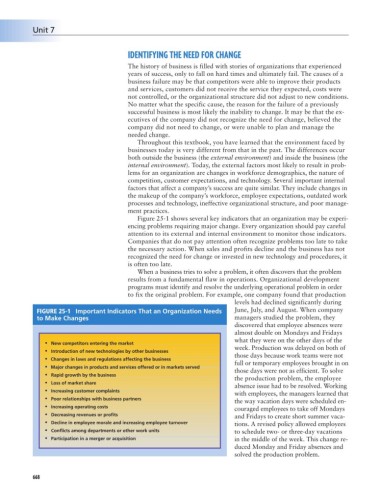
                                                   Figure 25-1 shows several key indicators that an organization may be experi-
                                                encing problems requiring major change. Every organization should pay careful
                                                attention to its external and internal environment to monitor those indicators.
                                                Companies that do not pay attention often recognize problems too late to take
                                                the necessary action. When sales and profits decline and the business has not
                                                recognized the need for change or invested in new technology and procedures, it
                                                is often too late.
                                                   When a business tries to solve a problem, it often discovers that the problem
                                                results from a fundamental flaw in operations. Organizational development
                                                programs must identify and resolve the underlying operational problem in order
                                                to fix the original problem. For example, one company found that production
                                                                                 levels had declined significantly during
                   FIGURE 25-1 Important Indicators That an Organization Needs   June, July, and August. When company
                   to Make Changes                                               managers studied the problem, they
                                                                                 discovered that employee absences were
                                                                                 almost double on Mondays and Fridays
                                                                                 what they were on the other days of the
                             New competitors entering the market
                                                                                 week. Production was delayed on both of
                             Introduction of new technologies by other businesses
                                                                                 those days because work teams were not
                            Changes in laws and regulations affecting the business
                                                                                 full or temporary employees brought in on
                            Major changes in products and services offered or in markets served
                                                                                 those days were not as efficient. To solve
                             Rapid growth by the business
                                                                                 the production problem, the employee
                             Loss of market share
                                                                                 absence issue had to be resolved. Working
                             Increasing customer complaints
                                                                                 with employees, the managers learned that
                             Poor relationships with business partners
                                                                                 the way vacation days were scheduled en-
                             Increasing operating costs
                                                                                 couraged employees to take off Mondays
                             Decreasing revenues or profits
                                                                                 and Fridays to create short summer vaca-
                             Decline in employee morale and increasing employee turnover
                                                                                 tions. A revised policy allowed employees
                             Conflicts among departments or other work units
                                                                                 to schedule two- or three-day vacations
                             Participation in a merger or acquisition           in the middle of the week. This change re-
                                                                                 duced Monday and Friday absences and
                                                                                 solved the production problem.
                  668

