


Page 426 - Basic College Mathematics with Early Integers
P. 426
S E C T I O N 5.5 I WEIGHT AND MASS: U.S. AND METRIC SYSTEMS OF MEASUREMENT               403


            Objective      Defining and Converting Metric System
                           Units of Mass

            In scientific and technical areas, a careful distinction is made between weight and
            mass. Weight is really a measure of the pull of gravity. The farther from Earth an
            object gets, the less it weighs. However, mass is a measure of the amount of sub-
            stance in the object and does not change. Astronauts orbiting Earth weigh much
            less than they weigh on Earth, but they have the same mass in orbit as they do on
            Earth. Here on Earth, weight and mass are the same, so either term may be used.
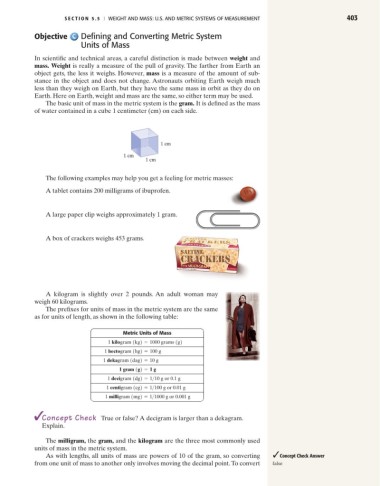
                The basic unit of mass in the metric system is the gram. It is defined as the mass
            of water contained in a cube 1 centimeter (cm) on each side.


                                                    1 cm

                                        1 cm
                                               1 cm

                The following examples may help you get a feeling for metric masses:

                A tablet contains 200 milligrams of ibuprofen.


                A large paper clip weighs approximately 1 gram.


                A box of crackers weighs 453 grams.


                A kilogram is slightly over 2 pounds. An adult woman may
            weigh 60 kilograms.
                The prefixes for units of mass in the metric system are the same
            as for units of length, as shown in the following table:

                                        Metric Units of Mass
                                    1 kilogram 1kg2 = 1000 grams 1g2
                                   1 hectogram 1hg2 = 100 g
                                   1 dekagram 1dag2 = 10 g
                                       1 gram 1g2 = 1 g
                                    1 decigram 1dg2 = 1>10 g or 0.1 g
                                    1 centigram 1cg2 = 1>100 g or 0.01 g
                                   1 milligram 1mg2 = 1>1000 g or 0.001 g


              Concept Check True or false? A decigram is larger than a dekagram.
              Explain.

                The milligram, the gram, and the kilogram are the three most commonly used
            units of mass in the metric system.
                As with lengths, all units of mass are powers of 10 of the gram, so converting  Concept Check Answer
            from one unit of mass to another only involves moving the decimal point.To convert  false

