


Page 428 - Basic College Mathematics with Early Integers
P. 428
S E C T I O N 5.5 I WEIGHT AND MASS: U.S. AND METRIC SYSTEMS OF MEASUREMENT               405


              Example 8     Convert 2.35 cg to grams.                                   PRACTICE 8
                                                                                        Convert 56.2 cg to grams.
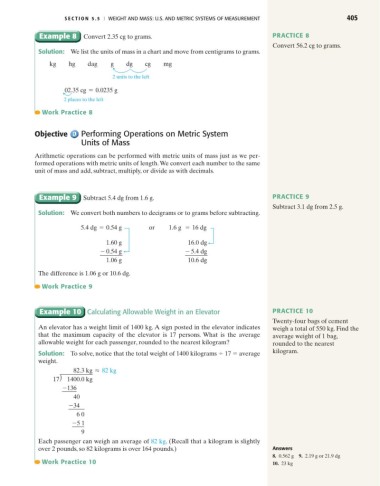
             Solution: We list the units of mass in a chart and move from centigrams to grams.
                 kg    hg    dag    g    dg    cg    mg

                                     2 units to the left

                      02.35 cg=0.0235 g
                     2 places to the left
              Work Practice 8


            Objective      Performing Operations on Metric System
                           Units of Mass

            Arithmetic operations can be performed with metric units of mass just as we per-
            formed operations with metric units of length.We convert each number to the same
            unit of mass and add, subtract, multiply, or divide as with decimals.


             Example 9      Subtract 5.4 dg from 1.6 g.                                 PRACTICE 9
                                                                                        Subtract 3.1 dg from 2.5 g.
             Solution: We convert both numbers to decigrams or to grams before subtracting.

                           5.4 dg=0.54 g         or    1.6 g =16 dg

                                   1.60 g                    16.0 dg
                                 – 0.54 g                   – 5.4 dg
                                   1.06 g                    10.6 dg
             The difference is 1.06 g or 10.6 dg.

              Work Practice 9


              Example 10 Calculating Allowable Weight in an Elevator                    PRACTICE 10
                                                                                        Twenty-four bags of cement
             An elevator has a weight limit of 1400 kg. A sign posted in the elevator indicates  weigh a total of 550 kg. Find the
             that the maximum capacity of the elevator is 17 persons. What is the average  average weight of 1 bag,
             allowable weight for each passenger, rounded to the nearest kilogram?      rounded to the nearest
                                                                                        kilogram.
             Solution: To solve, notice that the total weight of 1400 kilograms  17  average
             weight.
                        82.3 kg L 82 kg
                  17 1400.0 kg
                      -136
                        40
                       -34
                         60
                        -51
                           9
             Each passenger can weigh an average of 82 kg. (Recall that a kilogram is slightly
             over 2 pounds, so 82 kilograms is over 164 pounds.)                        Answers
                                                                                        8. 0.562 g  9. 2.19 g or 21.9 dg
              Work Practice 10                                                          10. 23 kg

