


Page 466 - Basic College Mathematics with Early Integers
P. 466
S E C T ION  6 .1 I PERCENTS, DECIMALS, AND FRACTIONS                 443


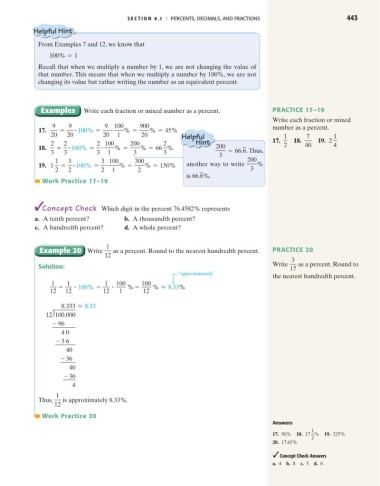
             From Examples 7 and 12, we know that

                 100% = 1
             Recall that when we multiply a number by 1, we are not changing the value of
             that number. This means that when we multiply a number by 100%, we are not
             changing its value but rather writing the number as an equivalent percent.


              Examples  Write each fraction or mixed number as a percent.               PRACTICE 17–19
                                                                                        Write each fraction or mixed
                  9    9          9  100      900                                       number as a percent.
             17.    =    #  100% =   #   % =     % = 45%
                 20   20          20  1       20                                            1      7       1
                                                                                        17.    18.    19. 2
                 2   2          2 100      200       2                                      2     40       4
             18.   =   #  100% =  #   % =     % = 66  %               200
                 3   3          3  1        3        3                    = 66.6.  Thus,
                                                                       3
                   1   3         3 100      300                                 200
             19. 1   =  #  100% =  #   % =     % = 150%      another way to write   %
                   2   2         2   1       2                                   3
                                                             is 66.6%.
              Work Practice 17–19


              Concept Check Which digit in the percent 76.4582% represents
            a. A tenth percent?          b. A thousandth percent?
            c. A hundredth percent?      d. A whole percent?


                                   1
              Example 20 Write       as a percent. Round to the nearest hundredth percent.  PRACTICE 20
                                  12
                                                                                              3
             Solution:                                                                  Write  17  as a percent. Round to
                                                          “approximately”
                                                                                        the nearest hundredth percent.
                 1    1  #        1  #  100   100
                 12 = 12  100%=   12   1  % =  12  %≠8.33%

                     8.333 L 8.33
                12100.000
                  - 96
                     40
                   - 36
                      40
                    - 36
                       40
                     - 36
                        4

                   1
             Thus,   is approximately 8.33%.
                  12
              Work Practice 20
                                                                                        Answers
                                                                                                    1
                                                                                        17. 50%  18. 17  %  19. 225%
                                                                                                    2
                                                                                        20. 17.65%
                                                                                          Concept Check Answers
                                                                                        a. 4  b. 8  c. 5  d. 6

