


Page 559 - Basic College Mathematics with Early Integers
P. 559
Objectives                  7.4       COUNTING AND INTRODUCTION TO PROBABILITY

           Use a Tree Diagram to Count
           Outcomes.
                                       Objective      Using a Tree Diagram
           Find the Probability of an Event
                                       In our daily conversations, we often talk about the likelihood or probability of a
                                       given result occurring. For example:
                                           The chance of thundershowers is 70 percent.
                                           What are the odds that the New Orleans Saints will go to the Super Bowl?
                                           What is the probability that you will finish cleaning your room today?
                                       Each of these chance happenings—thundershowers, the New Orleans Saints
                                       playing in the Super Bowl, and cleaning your room today—is called an
                                       experiment. The possible results of an experiment are called  outcomes. For
                                       example, flipping a coin is an experiment, and the possible outcomes are heads
                                       (H) or tails (T).
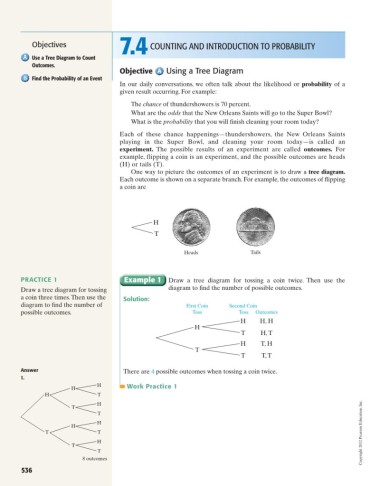
                                           One way to picture the outcomes of an experiment is to draw a tree diagram.
                                       Each outcome is shown on a separate branch. For example, the outcomes of flipping
                                       a coin are


                                                  H
                                                  T


                                                            Heads                Tails


        PRACTICE 1                       Example 1     Draw a tree diagram for tossing a coin twice. Then use the

        Draw a tree diagram for tossing                diagram to find the number of possible outcomes.
        a coin three times.Then use the  Solution:
        diagram to find the number of                        First Coin    Second Coin
        possible outcomes.                                    Toss           Toss  Outcomes
                                                                              H     H, H
                                                               H
                                                                              T     H,T
                                                                              H     T, H
                                                               T
                                                                              T     T,T

        Answer                          There are 4 possible outcomes when tossing a coin twice.
        1.
                                H         Work Practice 1
                        H
               H                T
                                H
                        T
                                T
                                H
                        H
               T                T                                                                                   Copyright 2012 Pearson Education, Inc.
                                H
                        T
                                T
                           8 outcomes
        536

