


Page 560 - Basic College Mathematics with Early Integers
P. 560
S E C T ION  7. 4 I COUNTING AND INTRODUCTION TO PROBABILITY                  537


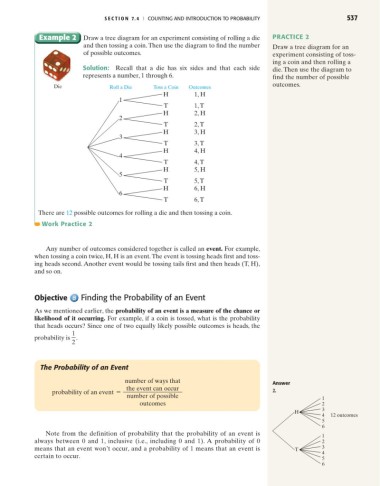
             Example 2      Draw a tree diagram for an experiment consisting of rolling a die  PRACTICE 2
                            and then tossing a coin. Then use the diagram to find the number  Draw a tree diagram for an
                            of possible outcomes.                                       experiment consisting of toss-
                                                                                        ing a coin and then rolling a
                           Solution:  Recall that a die has six sides and that each side  die. Then use the diagram to
                           represents a number, 1 through 6.                            find the number of possible
                  Die               Roll a Die    Toss a Coin  Outcomes                 outcomes.
                                                     H         1, H
                                       1
                                                     T         1,T
                                                     H         2, H
                                       2
                                                     T         2,T
                                                     H         3, H
                                       3
                                                     T         3,T
                                                     H         4, H
                                       4
                                                     T         4,T
                                                     H         5, H
                                       5
                                                     T         5,T
                                                     H         6, H
                                       6
                                                     T         6,T
             There are 12 possible outcomes for rolling a die and then tossing a coin.
              Work Practice 2


                Any number of outcomes considered together is called an event. For example,
            when tossing a coin twice, H, H is an event.The event is tossing heads first and toss-
            ing heads second. Another event would be tossing tails first and then heads (T, H),
            and so on.


            Objective      Finding the Probability of an Event

            As we mentioned earlier, the probability of an event is a measure of the chance or
            likelihood of it occurring. For example, if a coin is tossed, what is the probability
            that heads occurs? Since one of two equally likely possible outcomes is heads, the
                        1
            probability is  .
                        2


              The Probability of an Event

                                         number of ways that                            Answer
                                          the event can occur
                  probability of an event =                                             2.
                                         number of possible
                                                                                                        1
                                              outcomes                                                  2
                                                                                                        3
                                                                                               H
                                                                                                        4  12 outcomes
                                                                                                        5
                                                                                                        6
                Note from the definition of probability that the probability of an event is
                                                                                                        1
            always between 0 and 1, inclusive (i.e., including 0 and 1). A probability of 0             2
            means that an event won’t occur, and a probability of 1 means that an event is     T        3
                                                                                                        4
            certain to occur.
                                                                                                        5
                                                                                                        6

