


Page 593 - Basic College Mathematics with Early Integers
P. 593
Objectives                  8.2        SOLVING EQUATIONS: THE ADDITION PROPERTY

           Determine Whether a Given
           Number is a Solution of an
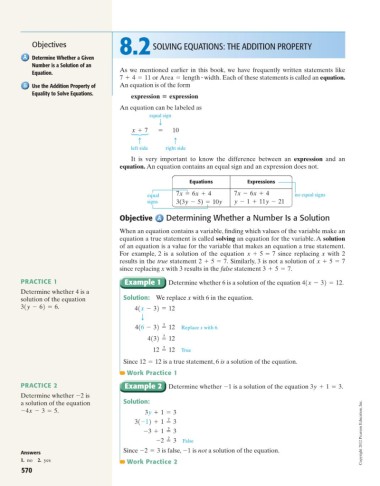
                                       As we mentioned earlier in this book, we have frequently written statements like
           Equation.
                                                                 #
                                       7 + 4 = 11  or Area = length width.  Each of these statements is called an equation.
           Use the Addition Property of  An equation is of the form
           Equality to Solve Equations.
                                           expression  expression
                                       An equation can be labeled as
                                                 equal sign
                                                    T
                                           x + 7    =   10
                                           3
                                             c           c
                                           left side  right side
                                           It is very important to know the difference between an  expression and an
                                       equation. An equation contains an equal sign and an expression does not.

                                                             Equations          Expressions
                                                         7x = 6x + 4        7x - 6x + 4
                                                equal                                          no equal signs
                                                signs    3(3y - 5) = 10y    y - 1 + 11y - 21

                                       Objective      Determining Whether a Number Is a Solution

                                       When an equation contains a variable, finding which values of the variable make an
                                       equation a true statement is called solving an equation for the variable. A solution
                                       of an equation is a value for the variable that makes an equation a true statement.
                                       For example, 2 is a solution of the equation  x + 5 = 7  since replacing  x with 2
                                       results in the true statement 2 + 5 = 7.  Similarly, 3 is not a solution of x + 5 = 7
                                       since replacing x with 3 results in the false statement 3 + 5 = 7.

        PRACTICE 1                       Example 1     Determine whether 6 is a solution of the equation 41x - 32 = 12.
        Determine whether 4 is a
        solution of the equation        Solution:  We replace x with 6 in the equation.
        31y - 62 = 6.                        41x - 32 = 12
                                              T

                                             416 - 32  12  Replace x with 6.

                                                 4132  12
                                                   12    12  True
                                        Since 12 = 12  is a true statement, 6 is a solution of the equation.
                                          Work Practice 1
        PRACTICE 2                       Example 2     Determine whether -1  is a solution of the equation 3y + 1 = 3.

        Determine whether -2  is
        a solution of the equation      Solution:
        -4x - 3 = 5.                            3y + 1 = 3
                                             31-12 + 1    3
                                                -3 + 1    3                                                        Copyright 2012 Pearson Education, Inc.
                                                    -2    3  False
                                        Since -2 = 3  is false, -1  is not a solution of the equation.
        Answers
        1. no  2. yes                     Work Practice 2
        570

