


Page 594 - Basic College Mathematics with Early Integers
P. 594
S E C T I O N  8.2 I SOLVING EQUATIONS: THE ADDITION PROPERTY                571


            Objective      Using the Addition Property to Solve Equations

            To solve an equation, we use properties of equality to write simpler equations, all
            equivalent to the original equation, until the final equation has the form
                x = number  or  number = x

            Equivalent equations have the same solution, so the word “number” above repre-
            sents the solution of the original equation. The first property of equality to help us
            write simpler, equivalent equations is the addition property of equality.


              Addition Property of Equality

              Let a, b, and c represent numbers.Then
                         a = b             Also,    a = b
                 and a + c = b + c        and a - c = b - c
                 are equivalent equations.  are equivalent equations.


            In other words, the same number may be added to or subtracted from both sides of
            an equation without changing the solution of the equation.
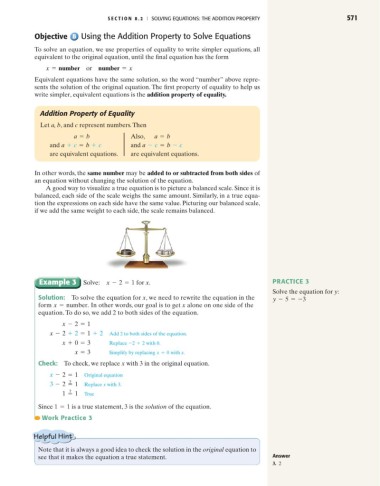
                A good way to visualize a true equation is to picture a balanced scale. Since it is
            balanced, each side of the scale weighs the same amount. Similarly, in a true equa-
            tion the expressions on each side have the same value. Picturing our balanced scale,
            if we add the same weight to each side, the scale remains balanced.


             Example 3      Solve:  x - 2 = 1  for x.                                   PRACTICE 3
                                                                                        Solve the equation for y:
             Solution:  To solve the equation for x, we need to rewrite the equation in the  y - 5 =-3
             form x = number.  In other words, our goal is to get x alone on one side of the
             equation. To do so, we add 2 to both sides of the equation.
                       x - 2 = 1
                   x - 2 + 2 = 1 + 2  Add 2 to both sides of the equation.
                       x + 0 = 3    Replace -2 + 2  with 0.
                           x = 3    Simplify by replacing x + 0  with x.
             Check: To check, we replace x with 3 in the original equation.
                   x - 2 = 1  Original equation
                   3 - 2    1  Replace x with 3.
                      1    1  True

             Since 1 = 1  is a true statement, 3 is the solution of the equation.
              Work Practice 3


             Note that it is always a good idea to check the solution in the original equation to
             see that it makes the equation a true statement.                           Answer
                                                                                        3. 2

