


Page 704 - Basic College Mathematics with Early Integers
P. 704
CHAPTER HIGHLIGHTS                          681


                       Definitions and Concepts                                      Examples

                                            Section 9.1  Lines and Angles (continued)


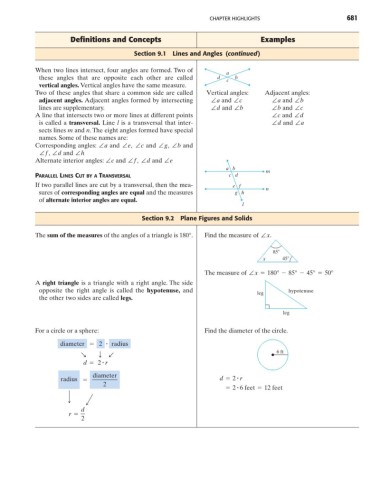
            When two lines intersect, four angles are formed. Two of
                                                                         a
             these angles that are opposite each other are called     d  c  b
             vertical angles. Vertical angles have the same measure.
            Two of these angles that share a common side are called  Vertical angles:  Adjacent angles:
             adjacent angles. Adjacent angles formed by intersecting  ∠a  and  ∠c       ∠a  and  ∠b
             lines are supplementary.                               ∠d  and  ∠b         ∠b  and  ∠c
            A line that intersects two or more lines at different points                ∠c  and  ∠d
             is called a transversal. Line l is a transversal that inter-               ∠d  and  ∠a
             sects lines m and n. The eight angles formed have special
             names. Some of these names are:
            Corresponding angles: ∠a  and  ∠e,  ∠c  and  ∠g,  ∠b  and
              ∠f,  ∠d  and ∠h
            Alternate interior angles: ∠c  and ∠f,  ∠d  and ∠e
                                                                         ab           m
            PARALLEL LINES CUT BY A TRANSVERSAL                           cd
            If two parallel lines are cut by a transversal, then the mea-  ef         n
             sures of corresponding angles are equal and the measures       gh
             of alternate interior angles are equal.
                                                                              l
                                              Section 9.2  Plane Figures and Solids


            The sum of the measures of the angles of a triangle is 180°.  Find the measure of ∠x.

                                                                                        85
                                                                                     x     45

                                                                  The measure of ∠x = 180° - 85° - 45° = 50°
            A right triangle is a triangle with a right angle. The side
             opposite the right angle is called the  hypotenuse, and                         hypotenuse
                                                                                   leg
             the other two sides are called legs.
                                                                                           leg


            For a circle or a sphere:                             Find the diameter of the circle.
                    diameter  =  2  #  radius
                                                                                         6 ft
                           R    T   b
                                  #
                            d =  2 r
                               diameter                                      #
                    radius  =                                          d = 2 r
                                  2
                                                                             #
                                                                         = 2 6 feet = 12 feet
                      ∂     ∂
                           d
                       r =
                           2

