


Page 1063 - Basic Electrical Engineering
P. 1063
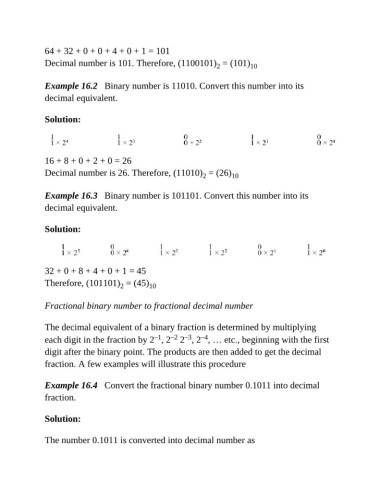
64 + 32 + 0 + 0 + 4 + 0 + 1 = 101
               Decimal number is 101. Therefore, (1100101)  = (101)               10
                                                                       2


               Example 16.2   Binary number is 11010. Convert this number into its
               decimal equivalent.


               Solution:


               16 + 8 + 0 + 2 + 0 = 26
               Decimal number is 26. Therefore, (11010)  = (26)             10
                                                                  2


               Example 16.3   Binary number is 101101. Convert this number into its
               decimal equivalent.


               Solution:


               32 + 0 + 8 + 4 + 0 + 1 = 45
               Therefore, (101101)  = (45)       10
                                        2


               Fractional binary number to fractional decimal number


               The decimal equivalent of a binary fraction is determined by multiplying

                                                        –2
                                                   –1
                                                            –3
                                                                  –4
               each digit in the fraction by 2 , 2  2 , 2 , … etc., beginning with the first
               digit after the binary point. The products are then added to get the decimal
               fraction. A few examples will illustrate this procedure

               Example 16.4   Convert the fractional binary number 0.1011 into decimal
               fraction.


               Solution:


               The number 0.1011 is converted into decimal number as

