


Page 427 - Basic Electrical Engineering
P. 427
motors, as will be explained in a separate chapter, a separate starting winding is required;
                  iii.  electrical power transmission from the generating station to the places of use is done by
                     transmission lines. It has been seen that three-phase power transmission is more economical
                     than single-phase power transmission;
                  iv.  the power factor of three-phase systems is better than that of the single-phase systems;
                   v.  single-phase supply can also be obtained from a three-phase supply;
                  vi.  the instantaneous power in a single-phase system is fluctuating with time giving rise to noisy
                     performance of single-phase motors. The power output of a symmetrical three-phase system is
                     steady;
                 vii.  for rectification of ac into dc, the dc output voltage becomes less fluctuating if the number of
                     phases is increased.


               Thus, we see that from generation, transmission, distribution, and utilization

               points of view, three-phase systems are preferred over single-phase systems
               due to a number of reasons mentioned above.


                                     4.3 GENERATION OF THREE-PHASE VOLTAGES

               Due to a number of practical considerations, generators are built to generate
               poly-phase voltages. Commercial generators are built to generate three-phase

               voltages. In three-phase generators, three separate windings are made.
               Windings are made of coils. These windings are placed in stator slots at an

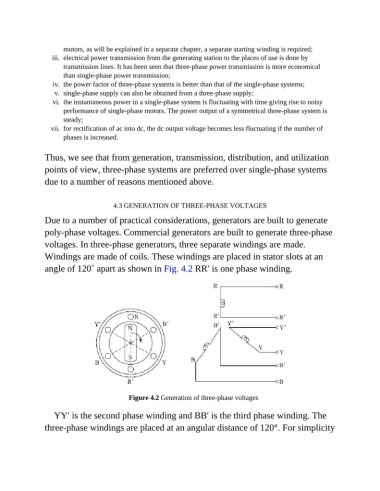
               angle of 120˚ apart as shown in Fig. 4.2 RR′ is one phase winding.


                                          Figure 4.2 Generation of three-phase voltages

                  YY′ is the second phase winding and BB′ is the third phase winding. The

               three-phase windings are placed at an angular distance of 120°. For simplicity

