


Page 439 - Basic Electrical Engineering
P. 439
If per phase power is P  and total power is P ,
                                           h
                                                                     T

               then                 P  = 3 P                  (4.8)
                                           h
                                   T

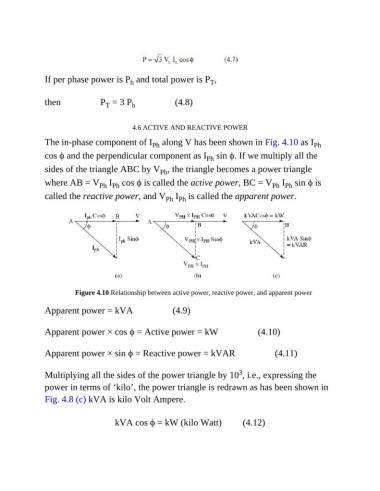
                                            4.6 ACTIVE AND REACTIVE POWER

               The in-phase component of I  along V has been shown in Fig. 4.10 as I                  Ph
                                                  Ph
               cos ϕ and the perpendicular component as I  sin ϕ. If we multiply all the
                                                                    Ph
               sides of the triangle ABC by V , the triangle becomes a power triangle
                                                     Ph
               where AB = V  I  cos ϕ is called the active power, BC = V  I  sin ϕ is
                                 Ph Ph
                                                                                         Ph Ph
               called the reactive power, and V  I  is called the apparent power.
                                                      Ph Ph


                         Figure 4.10 Relationship between active power, reactive power, and apparent power


               Apparent power = kVA                 (4.9)


               Apparent power × cos ϕ = Active power = kW                 (4.10)


               Apparent power × sin ϕ = Reactive power = kVAR                 (4.11)


                                                                              3
               Multiplying all the sides of the power triangle by 10 , i.e., expressing the
               power in terms of ‘kilo’, the power triangle is redrawn as has been shown in

               Fig. 4.8 (c) kVA is kilo Volt Ampere.

                                      kVA cos ϕ = kW (kilo Watt)         (4.12)

