


Page 529 - Basic Electrical Engineering
P. 529
to reduce the cost of transmission. High-voltage transmission reduces the size
               of transmission line conductors thereby reducing the weight of the
               conducting material used. Since power is the product of voltage and current,

               for the same power if voltage is increased, the magnitude of current will
               decrease. For transmitting at this reduced current, the size of the line

               conductors will reduce, and hence the cost gets reduced. The power house
               wherefrom electricity is transmitted through transmission lines is called the

               ‘sending end’ whereas the other end of the transmission lines where the
               electricity is received for use is called the ‘receiving end’. At the sending end

               the voltage level is increased using step-up transformers before, connecting to
               the transmission lines, while at the receiving end the voltage level is lowered
               before the distribution of electricity for use. The voltage level is raised for

               reducing the cost of transmission while it is again lowered before supplying
               to consumers, for safety reasons. Consumers use electricity at 230 V or at 400

               V.


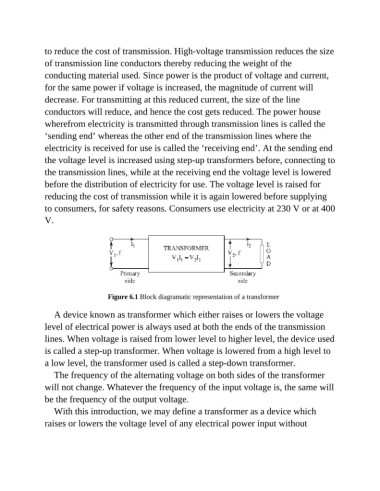
                                    Figure 6.1 Block diagramatic representation of a transformer


                  A device known as transformer which either raises or lowers the voltage
               level of electrical power is always used at both the ends of the transmission

               lines. When voltage is raised from lower level to higher level, the device used
               is called a step-up transformer. When voltage is lowered from a high level to
               a low level, the transformer used is called a step-down transformer.

                  The frequency of the alternating voltage on both sides of the transformer
               will not change. Whatever the frequency of the input voltage is, the same will

               be the frequency of the output voltage.
                  With this introduction, we may define a transformer as a device which

               raises or lowers the voltage level of any electrical power input without

