


Page 660 - Basic Electrical Engineering
P. 660
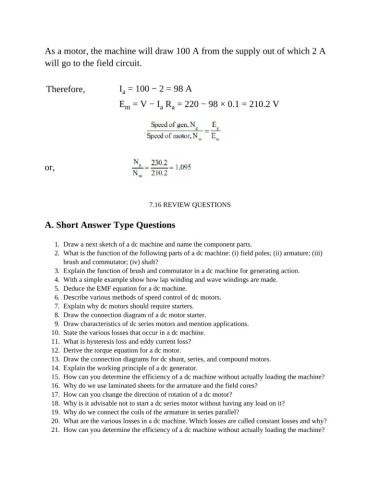
As a motor, the machine will draw 100 A from the supply out of which 2 A
               will go to the field circuit.


                Therefore,             I  = 100 − 2 = 98 A
                                        a
                                       E  = V − I  R  = 220 − 98 × 0.1 = 210.2 V
                                                     a
                                                        a
                                         m


               or,


                                                 7.16 REVIEW QUESTIONS


               A. Short Answer Type Questions


                   1.  Draw a next sketch of a dc machine and name the component parts.
                   2.  What is the function of the following parts of a dc machine: (i) field poles; (ii) armature; (iii)
                     brush and commutator; (iv) shaft?
                   3.  Explain the function of brush and commutator in a dc machine for generating action.
                   4.  With a simple example show how lap winding and wave windings are made.
                   5.  Deduce the EMF equation for a dc machine.
                   6.  Describe various methods of speed control of dc motors.
                   7.  Explain why dc motors should require starters.
                   8.  Draw the connection diagram of a dc motor starter.
                   9.  Draw characteristics of dc series motors and mention applications.
                 10.  State the various losses that occur in a dc machine.
                 11.  What is hysteresis loss and eddy current loss?
                 12.  Derive the torque equation for a dc motor.
                 13.  Draw the connection diagrams for dc shunt, series, and compound motors.
                 14.  Explain the working principle of a dc generator.
                 15.  How can you determine the efficiency of a dc machine without actually loading the machine?
                 16.  Why do we use laminated sheets for the armature and the field cores?
                 17.  How can you change the direction of rotation of a dc motor?
                 18.  Why is it advisable not to start a dc series motor without having any load on it?
                 19.  Why do we connect the coils of the armature in series parallel?
                 20.  What are the various losses in a dc machine. Which losses are called constant losses and why?
                 21.  How can you determine the efficiency of a dc machine without actually loading the machine?

