


Page 754 - Basic Electrical Engineering
P. 754
connections, stepped up to a higher voltage and transmitted through long
               transmission lines to be taken to places where electricity is required. The ac
               generators, also called the alternators, used for generation of electricity on a

               large scale are invariably three-phase ac generators. The generation of
               voltage is based on the basic principle that when there is relative motion

               between a conductor and a magnetic field, EMF is induced in the conductor.
               This is called the generating action. The same machine will work as a motor

               when electrical energy is the input and mechanical energy is the output. A
               motor works on the basic principle that when a current carrying conductor is

               placed in a magnetic field, it experiences a force. Thus, the electro-
               mechanical energy conversion that takes place in an electrical machine is a
               reversible process. That is the same machine works as a generator when

               mechanical energy is converted into electrical energy and as a motor when
               electrical energy is converted into mechanical output.


                            10.2 CONSTRUCTIONAL DETAILS OF SYNCHRONOUS MACHINES

               In a three phase synchronous generator, a set of coils are placed in slots

               inside a hollow cylindrical stator. The coils are wound for different number
               of poles. Magnetic poles are formed on the rotor and are rotated by a prime
               mover, i.e., a turbine. The rotating poles produce a flux which cuts the stator

               conductors. Because of the cutting of flux by the coil sides, i.e., conductors,
               EMF is induced in them.

                  The poles forming the rotor are rotated at a constant speed, called the
               synchronous speed so that EMF of constant frequency is generated. Normally
               the electricity generated is for 50 cycles per second. The relationship between

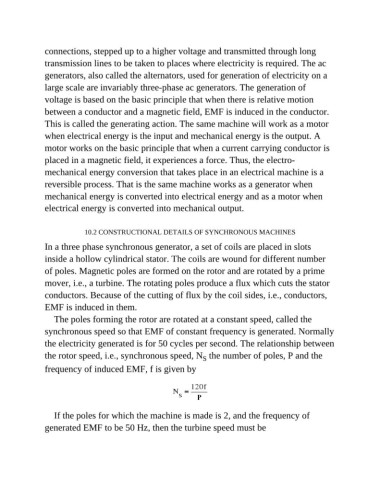
               the rotor speed, i.e., synchronous speed, N  the number of poles, P and the
                                                                  S
               frequency of induced EMF, f is given by


                  If the poles for which the machine is made is 2, and the frequency of

               generated EMF to be 50 Hz, then the turbine speed must be

