


Page 803 - Basic Electrical Engineering
P. 803
important in any engineering and scientific activity. If we want to control a
               certain quantity, e.g., the output voltage of a generator, we have to
               continuously measure the output voltage because it tends to change when the

               load on the generator changes. If we want to keep the output voltage constant
               even when the load on the generator changes, we have to measure and send

               feedback to the generator input devices to make corrections for the desired
               output. Sometimes measurement has to be done from a distant place. In such

               cases the measured data have to be acquired, converted to digital form,
               transmitted, again converted to analog form and recorded. The input signals

               received through a transducer are required to be processed, i.e., amplified or
               attenuated, filtered, and converted before transmitting to the desired
               destination. Signal conditioning, data acquisition, data transmission, etc., are

               the important components of an instrumentation system.
                  Application of computers in industrial process control and monitoring has

               necessitated the requirement for instruments to measure, record, and control
               process variables.

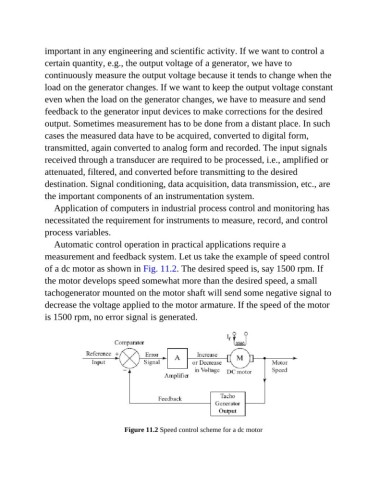
                  Automatic control operation in practical applications require a
               measurement and feedback system. Let us take the example of speed control

               of a dc motor as shown in Fig. 11.2. The desired speed is, say 1500 rpm. If
               the motor develops speed somewhat more than the desired speed, a small
               tachogenerator mounted on the motor shaft will send some negative signal to

               decrease the voltage applied to the motor armature. If the speed of the motor
               is 1500 rpm, no error signal is generated.


                                         Figure 11.2 Speed control scheme for a dc motor

