


Page 808 - Basic Electrical Engineering
P. 808
However, if the consequitive readings taken were closely spread near 100 V
               i.e., 100.01, 100.02, 99.09, 100.01, 99.08, we could say that the instrument is
               precise as well as accurate.

                  It is an usual practice to record a measurement with all digits which can be
               read with surity about the true value. For example, a resistor of true value 25

               Ω if read as 25 Ω, than we may say that its value is nearer to 25 Ω than to 24
               Ω or 26 Ω. If the value of the resistor is expressed as 25.0 Ω, it would mean

               that the resistor is closer to 25.1 Ω or 24.9 Ω. In 25 Ω there are two
               significant figures and in 25.0 Ω there are three significant figures. An

               indication of the precision of measurement is given from the number of
               significant figures in which the measurement reading is expressed. The more
               is the number of significant figures used in recording the measurement value,

               the more is the precision of measurement.


                                          11.4.3 Sensitivity and Resolution


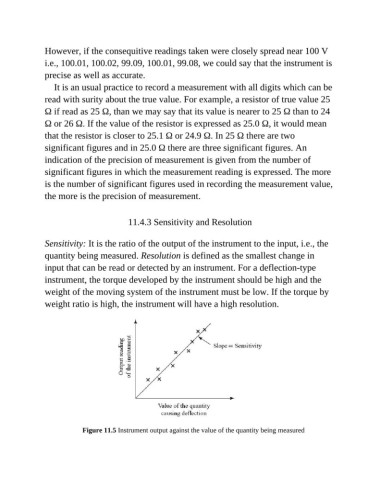
               Sensitivity: It is the ratio of the output of the instrument to the input, i.e., the

               quantity being measured. Resolution is defined as the smallest change in
               input that can be read or detected by an instrument. For a deflection-type

               instrument, the torque developed by the instrument should be high and the
               weight of the moving system of the instrument must be low. If the torque by

               weight ratio is high, the instrument will have a high resolution.


                            Figure 11.5 Instrument output against the value of the quantity being measured

