


Page 810 - Basic Electrical Engineering
P. 810
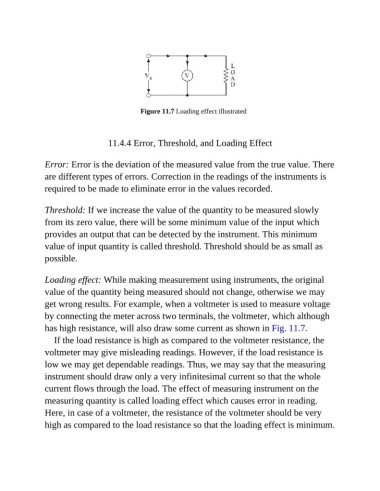
Figure 11.7 Loading effect illustrated


                                    11.4.4 Error, Threshold, and Loading Effect


               Error: Error is the deviation of the measured value from the true value. There

               are different types of errors. Correction in the readings of the instruments is
               required to be made to eliminate error in the values recorded.


               Threshold: If we increase the value of the quantity to be measured slowly
               from its zero value, there will be some minimum value of the input which
               provides an output that can be detected by the instrument. This minimum

               value of input quantity is called threshold. Threshold should be as small as
               possible.


               Loading effect: While making measurement using instruments, the original
               value of the quantity being measured should not change, otherwise we may

               get wrong results. For example, when a voltmeter is used to measure voltage
               by connecting the meter across two terminals, the voltmeter, which although

               has high resistance, will also draw some current as shown in Fig. 11.7.
                  If the load resistance is high as compared to the voltmeter resistance, the
               voltmeter may give misleading readings. However, if the load resistance is

               low we may get dependable readings. Thus, we may say that the measuring
               instrument should draw only a very infinitesimal current so that the whole

               current flows through the load. The effect of measuring instrument on the
               measuring quantity is called loading effect which causes error in reading.
               Here, in case of a voltmeter, the resistance of the voltmeter should be very

               high as compared to the load resistance so that the loading effect is minimum.

