


Page 896 - Basic Electrical Engineering
P. 896
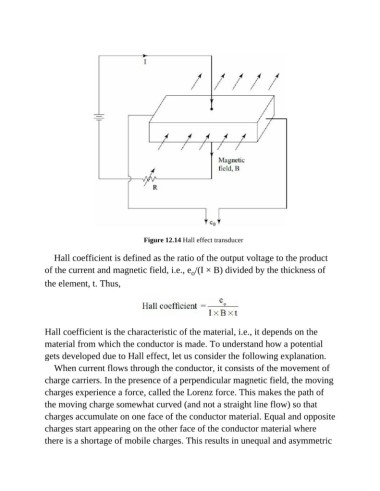
Figure 12.14 Hall effect transducer

                  Hall coefficient is defined as the ratio of the output voltage to the product

               of the current and magnetic field, i.e., e /(I × B) divided by the thickness of
                                                               o
               the element, t. Thus,


               Hall coefficient is the characteristic of the material, i.e., it depends on the

               material from which the conductor is made. To understand how a potential
               gets developed due to Hall effect, let us consider the following explanation.

                  When current flows through the conductor, it consists of the movement of
               charge carriers. In the presence of a perpendicular magnetic field, the moving
               charges experience a force, called the Lorenz force. This makes the path of

               the moving charge somewhat curved (and not a straight line flow) so that
               charges accumulate on one face of the conductor material. Equal and opposite

               charges start appearing on the other face of the conductor material where
               there is a shortage of mobile charges. This results in unequal and asymmetric

