


Page 914 - Basic Electrical Engineering
P. 914
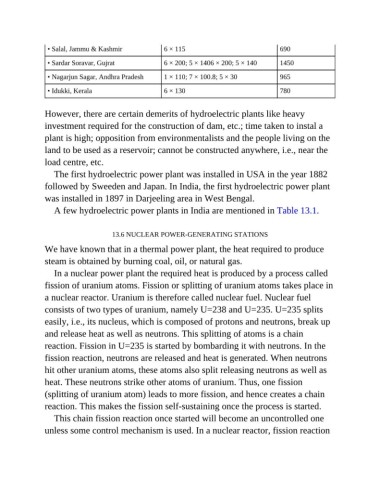
• Salal, Jammu & Kashmir              6 × 115                              690

                • Sardar Soravar, Gujrat              6 × 200; 5 × 1406 × 200; 5 × 140     1450

                • Nagarjun Sagar, Andhra Pradesh      1 × 110; 7 × 100.8; 5 × 30           965

                • Idukki, Kerala                      6 × 130                              780


               However, there are certain demerits of hydroelectric plants like heavy

               investment required for the construction of dam, etc.; time taken to instal a
               plant is high; opposition from environmentalists and the people living on the

               land to be used as a reservoir; cannot be constructed anywhere, i.e., near the
               load centre, etc.
                  The first hydroelectric power plant was installed in USA in the year 1882

               followed by Sweeden and Japan. In India, the first hydroelectric power plant
               was installed in 1897 in Darjeeling area in West Bengal.

                  A few hydroelectric power plants in India are mentioned in Table 13.1.


                                     13.6 NUCLEAR POWER-GENERATING STATIONS

               We have known that in a thermal power plant, the heat required to produce
               steam is obtained by burning coal, oil, or natural gas.
                  In a nuclear power plant the required heat is produced by a process called

               fission of uranium atoms. Fission or splitting of uranium atoms takes place in
               a nuclear reactor. Uranium is therefore called nuclear fuel. Nuclear fuel

               consists of two types of uranium, namely U=238 and U=235. U=235 splits
               easily, i.e., its nucleus, which is composed of protons and neutrons, break up

               and release heat as well as neutrons. This splitting of atoms is a chain
               reaction. Fission in U=235 is started by bombarding it with neutrons. In the

               fission reaction, neutrons are released and heat is generated. When neutrons
               hit other uranium atoms, these atoms also split releasing neutrons as well as
               heat. These neutrons strike other atoms of uranium. Thus, one fission

               (splitting of uranium atom) leads to more fission, and hence creates a chain
               reaction. This makes the fission self-sustaining once the process is started.

                  This chain fission reaction once started will become an uncontrolled one
               unless some control mechanism is used. In a nuclear reactor, fission reaction

