


Page 949 - Basic Electrical Engineering
P. 949
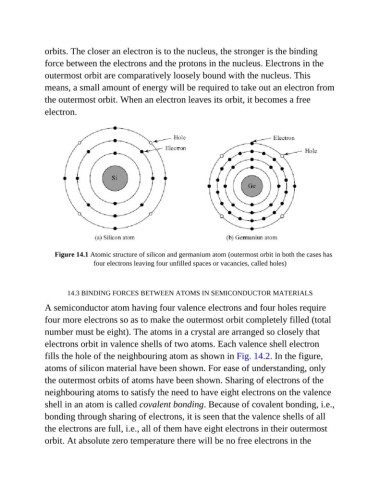
orbits. The closer an electron is to the nucleus, the stronger is the binding
               force between the electrons and the protons in the nucleus. Electrons in the
               outermost orbit are comparatively loosely bound with the nucleus. This

               means, a small amount of energy will be required to take out an electron from
               the outermost orbit. When an electron leaves its orbit, it becomes a free

               electron.


                   Figure 14.1 Atomic structure of silicon and germanium atom (outermost orbit in both the cases has
                               four electrons leaving four unfilled spaces or vacancies, called holes)


                       14.3 BINDING FORCES BETWEEN ATOMS IN SEMICONDUCTOR MATERIALS

               A semiconductor atom having four valence electrons and four holes require

               four more electrons so as to make the outermost orbit completely filled (total
               number must be eight). The atoms in a crystal are arranged so closely that

               electrons orbit in valence shells of two atoms. Each valence shell electron
               fills the hole of the neighbouring atom as shown in Fig. 14.2. In the figure,

               atoms of silicon material have been shown. For ease of understanding, only
               the outermost orbits of atoms have been shown. Sharing of electrons of the
               neighbouring atoms to satisfy the need to have eight electrons on the valence

               shell in an atom is called covalent bonding. Because of covalent bonding, i.e.,
               bonding through sharing of electrons, it is seen that the valence shells of all

               the electrons are full, i.e., all of them have eight electrons in their outermost
               orbit. At absolute zero temperature there will be no free electrons in the

