


Page 952 - Basic Electrical Engineering
P. 952
N-Type semiconductor is formed by doping a pure silicon or germanium
               crystal with a material having five valence electrons. Antimony, arsenic, and
               phosphorous are pentavalent materials as can be read from the periodic table.

               If arsenic in very small quantity is added to a silicon crystal, four out of five
               valence electrons will form covalent bonds with silicon atoms with one

               electron left free. Thus, for each arsenic atom there will be one free electron.
               Although the percentage of arsenic added is very small, the number of atoms

               being very large, a huge amount of free electrons will be available in the n-
               type semiconductor. These electrons being free (not taking part in any

               covalent bonding) are loosely bound to their parent atom and are free to
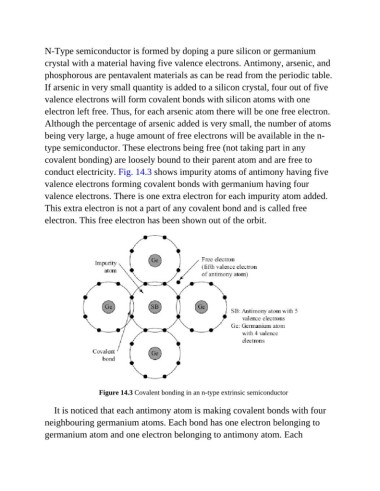
               conduct electricity. Fig. 14.3 shows impurity atoms of antimony having five
               valence electrons forming covalent bonds with germanium having four

               valence electrons. There is one extra electron for each impurity atom added.
               This extra electron is not a part of any covalent bond and is called free

               electron. This free electron has been shown out of the orbit.


                                 Figure 14.3 Covalent bonding in an n-type extrinsic semiconductor

                  It is noticed that each antimony atom is making covalent bonds with four
               neighbouring germanium atoms. Each bond has one electron belonging to

               germanium atom and one electron belonging to antimony atom. Each

