


Page 13 - Bulletin Vol 31 No 2 - May - Aug. 2026 Final
P. 13
In Our Society |   NCDS Dental Hygiene Award


                                         Every  year  the  Nassau  County  Dental  Society  presents  a  graduating
                                         Hygienist from Farmingdale State College our “Hygiene Community Service
                                         Award.” It gives recognition to their dedication and selfless commitment
                                         to  serving  the  community  and  improving  the  lives  of  others.  This  year
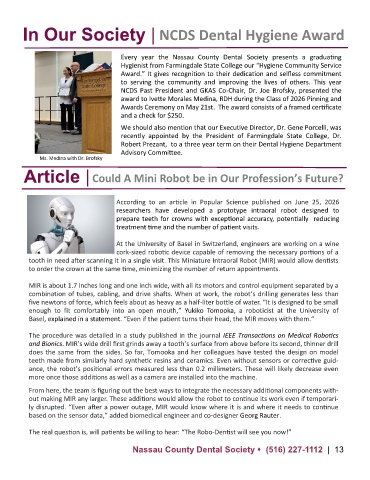
                                         NCDS  Past President  and  GKAS  Co-Chair,  Dr.  Joe  Brofsky, presented the
                                         award to Ivette Morales Medina, RDH during the Class of 2026 Pinning and
                                         Awards Ceremony on May 21st.  The award consists of a framed certificate
                                         and a check for $250.

                                         We should also mention that our Executive Director, Dr. Gene Porcelli, was
                                         recently  appointed  by  the  President  of  Farmingdale  State  College,  Dr.
                                         Robert Prezant,  to a three year term on their Dental Hygiene Department
                                         Advisory Committee.
              Ms. Medina with Dr. Brofsky


         Article |   Could A Mini Robot be in Our Profession’s Future?


                                        According  to  an  article  in  Popular  Science  published  on  June  25,  2026
                                        researchers  have  developed  a  prototype  intraoral  robot  designed  to
                                        prepare teeth for crowns with exceptional accuracy, potentially  reducing
                                        treatment time and the number of patient visits.

                                        At the University of Basel in Switzerland, engineers are working on a wine
                                        cork-sized robotic device capable of removing the necessary portions of a
           tooth in need after scanning it in a single visit. This Miniature Intraoral Robot (MIR) would allow dentists
           to order the crown at the same time, minimizing the number of return appointments.

           MIR is about 1.7 inches long and one inch wide, with all its motors and control equipment separated by a
           combination of tubes, cabling, and drive shafts. When at work, the robot’s drilling generates less than
           five newtons of force, which feels about as heavy as a half-liter bottle of water. “It is designed to be small
           enough  to  fit  comfortably  into  an  open  mouth,”  Yukiko  Tomooka,  a  roboticist  at  the  University  of
           Basel, explained in a statement. “Even if the patient turns their head, the MIR moves with them.”

           The procedure was detailed in a study published in the journal IEEE Transactions on Medical Robotics
           and Bionics. MIR’s wide drill first grinds away a tooth’s surface from above before its second, thinner drill
           does the same from the sides. So far, Tomooka and her colleagues have tested the design on model
           teeth made from similarly hard synthetic resins and ceramics. Even without sensors or corrective guid-
           ance, the robot’s positional errors measured less than 0.2 millimeters. These will likely decrease even
           more once those additions as well as a camera are installed into the machine.

           From here, the team is figuring out the best ways to integrate the necessary additional components with-
           out making MIR any larger. These additions would allow the robot to continue its work even if temporari-
           ly disrupted. “Even after a power outage, MIR would know where it is and where it needs to continue
           based on the sensor data,” added biomedical engineer and co-designer Georg Rauter.

           The real question is, will patients be willing to hear: “The Robo-Dentist will see you now!”


                                             Nassau County Dental Society ⬧  (516) 227-1112  |  13

