


Page 18 - Bulletin Vol 31 No 2 - May - Aug. 2026 Final
P. 18
In Our Society |  Empire Report Op-Ed

         Technology Like Hospital CT Scanners
         New York Should Not Regulate Dental Radiation


         By Michael Herrmann | July 7, 2026

                                New  York’s  dentists  share  the  Department  of  Health’s  commitment  to  patient
                                safety. Every day, dental professionals across our state rely on advanced technolo-
                                gies to improve diagnosis, treatment planning and patient outcomes. Among the
                                most important of these innovations is cone beam computed tomography (CBCT), a
                                specialized imaging technology that has transformed modern dental care.


                                That is why the New York State Dental Association (NYSDA) and the New York State
                                 Society of Oral and Maxillofacial Surgeons (NYSSOMS) strongly support appropri-
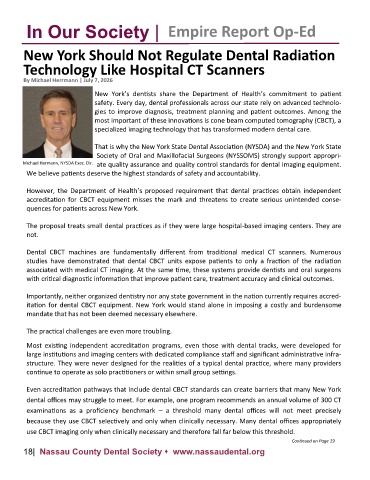
         Michael Hermann, NYSDA Exec. Dir.   ate quality assurance and quality control standards for dental imaging equipment.
          We believe patients deserve the highest standards of safety and accountability.


          However,  the  Department  of  Health’s  proposed  requirement  that  dental  practices  obtain  independent
          accreditation  for  CBCT  equipment  misses  the  mark  and  threatens  to  create  serious  unintended  conse-
          quences for patients across New York.


          The proposal treats small dental practices as if they were large hospital-based imaging centers. They are
          not.

          Dental  CBCT  machines  are  fundamentally  different  from  traditional  medical  CT  scanners.  Numerous
          studies  have  demonstrated  that  dental  CBCT  units  expose  patients  to  only  a  fraction  of  the  radiation
          associated with medical CT imaging. At the same time, these systems provide dentists and oral surgeons
          with critical diagnostic information that improve patient care, treatment accuracy and clinical outcomes.

          Importantly, neither organized dentistry nor any state government in the nation currently requires accred-
          itation for dental CBCT equipment. New York would stand alone in imposing a costly and burdensome
          mandate that has not been deemed necessary elsewhere.


          The practical challenges are even more troubling.

          Most  existing  independent  accreditation  programs,  even  those  with  dental  tracks,  were  developed  for
          large institutions and imaging centers with dedicated compliance staff and significant administrative infra-
          structure. They were never designed for the realities of a typical dental practice, where many providers
          continue to operate as solo practitioners or within small group settings.


          Even accreditation pathways that include dental CBCT standards can create barriers that many New York
          dental offices may struggle to meet. For example, one program recommends an annual volume of 300 CT
          examinations  as  a  proficiency  benchmark  –  a  threshold  many  dental  offices  will  not  meet  precisely
          because they use CBCT selectively and only when clinically necessary. Many dental offices appropriately
          use CBCT imaging only when clinically necessary and therefore fall far below this threshold.
                                                                                                  Continued on Page 19
         18|  Nassau County Dental Society ⬧  www.nassaudental.org

