


Page 189 - Computer Graphics Handout
P. 189
The  integration  of  computer  graphics  with  computer  networks  enables  distributed  and  collaborative  graphical  applications.
          Networked graphics systems allow graphical data to be generated, transmitted, and displayed across multiple computing nodes.
          Such systems support remote visualization, client–server rendering models, and cloud-based graphics processing. Efficient data
          communication,  synchronization,  and  resource  management  are  critical  challenges  in  networked  graphics  environments,
          particularly for real-time and high-resolution applications.


          5.5 X-Window System and X-Terminals


          The X-Window System is a network-transparent windowing system designed to support graphical user interfaces in distributed
          computing environments. It is based on a client–server architecture, where application programs act as clients and the X server is
          responsible for controlling the display, keyboard, and pointing devices.
          At the core of the X-Window System is the X Protocol, a communication protocol specialized for graphical operations such as window
          creation, drawing graphical primitives, displaying text, and handling user input events. The protocol is largely hardware-independent
          and can operate over various communication mechanisms, including interprocess communication on a local machine or TCP/IP
          connections over a computer network.
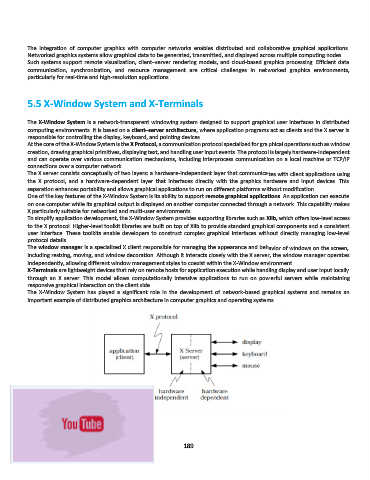
          The X server consists conceptually of two layers: a hardware-independent layer that communicates with client applications using
          the  X  protocol,  and  a  hardware-dependent  layer  that  interfaces  directly  with  the  graphics  hardware  and  input  devices.  This
          separation enhances portability and allows graphical applications to run on different platforms without modification.
          One of the key features of the X-Window System is its ability to support remote graphical applications. An application can execute
          on one computer while its graphical output is displayed on another computer connected through a network. This capability makes
          X particularly suitable for networked and multi-user environments.
          To simplify application development, the X-Window System provides supporting libraries such as Xlib, which offers low-level access
          to the X protocol. Higher-level toolkit libraries are built on top of Xlib to provide standard graphical components and a consistent
          user interface. These toolkits enable developers to construct complex graphical interfaces  without directly managing low-level
          protocol details.
          The window manager is a specialized X client responsible for managing the appearance and behavior of windows on the screen,
          including resizing, moving, and window decoration. Although it interacts closely with the X server, the window manager operates
          independently, allowing different window management styles to coexist within the X-Window environment.
          X-Terminals are lightweight devices that rely on remote hosts for application execution while handling display and user input locally
          through  an  X  server.  This  model  allows  computationally  intensive  applications  to  run  on  powerful  servers  while  maintaining
          responsive graphical interaction on the client side.
          The  X-Window  System  has  played  a  significant  role  in  the  development  of  network-based  graphical  systems  and  remains  an
          important example of distributed graphics architecture in computer graphics and operating systems.


                                                             189

