


Page 81 - Australian Wood Review №103 2019
P. 81
PROJECT


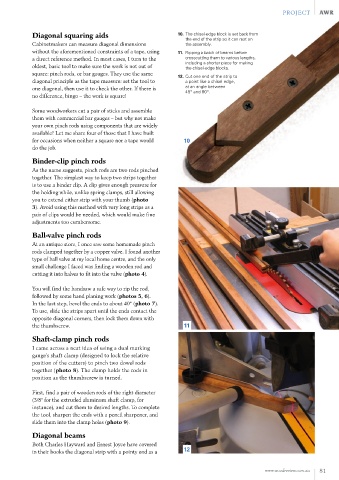
                Diagonal squaring aids                                                10. The chisel-edge block is set back from
                                                                                          the end of the strip so it can rest on
                Cabinetmakers can measure diagonal dimensions                             the assembly.

                without the aforementioned constraints of a tape, using               11.  Ripping a batch of beams before
                a direct reference method. In most cases, I turn to the                   crosscutting them to various lengths,
                                                                                          including a shorter piece for making
                oldest, basic tool to make sure the work is not out of                    the chisel-edge blocks.
                square: pinch rods, or bar gauges. They use the same
                                                                                      12. Cut one end of the strip to
                diagonal principle as the tape measure: set the tool to                   a point like a chisel edge,
                one diagonal, then use it to check the other. If there is                 at an angle between
                                                                                          45° and 60°.
                no difference, bingo – the work is square!


                Some woodworkers cut a pair of sticks and assemble

                them with commercial bar gauges – but why not make
                your own pinch rods using components that are widely
                available? Let me share four of those that I have built
                for occasions when neither a square nor a tape would                     10

                do the job.

                Binder-clip pinch rods

                As the name suggests, pinch rods are two rods pinched
                together. The simplest way to keep two strips together
                is to use a binder clip. A clip gives enough pressure for

                the holding while, unlike spring clamps, still allowing
                you to extend either strip with your thumb (photo
                3). Avoid using this method with very long strips as a
                pair of clips would be needed, which would make fine

                adjustments too cumbersome.

                Ball-valve pinch rods

                At an antique store, I once saw some homemade pinch
                rods clamped together by a copper valve. I found another

                type of ball valve at my local home centre, and the only
                small challenge I faced was finding a wooden rod and
                cutting it into halves to fit into the valve (photo 4).


                You will find the bandsaw a safe way to rip the rod,
                followed by some hand planing work (photos 5, 6).
                In the last step, bevel the ends to about 40° (photo 7).
                To use, slide the strips apart until the ends contact the
                opposite diagonal corners, then lock them down with

                the thumbscrew.                                                          11

                Shaft-clamp pinch rods

                I came across a neat idea of using a dual marking

                gauge’s shaft clamp (designed to lock the relative
                position of the cutters) to pinch two dowel rods
                together (photo 8). The clamp holds the rods in
                position as the thumbscrew is turned.


                First, find a pair of wooden rods of the right diameter
                (3/8" for the extruded aluminum shaft clamp, for
                instance), and cut them to desired lengths. To complete
                the tool, sharpen the ends with a pencil sharpener, and

                slide them into the clamp holes (photo 9).

                Diagonal beams

                Both Charles Hayward and Ernest Joyce have covered
                                                                                         12
                in their books the diagonal strip with a pointy end as a


                                                                                                                                www.woodreview.com.au     81

