


Page 110 - phytochemistry I - PharmD Clinical
P. 110
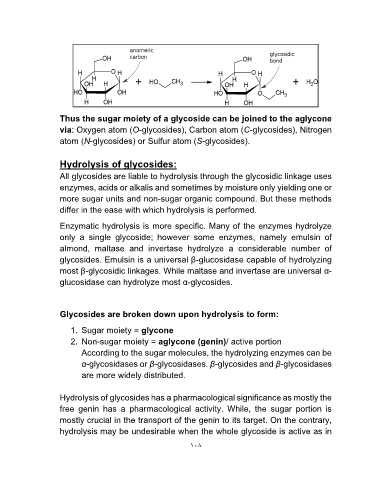
Thus the sugar moiety of a glycoside can be joined to the aglycone
via: Oxygen atom (O-glycosides), Carbon atom (C-glycosides), Nitrogen
atom (N-glycosides) or Sulfur atom (S-glycosides).

Hydrolysis of glycosides:

All glycosides are liable to hydrolysis through the glycosidic linkage uses
enzymes, acids or alkalis and sometimes by moisture only yielding one or
more sugar units and non-sugar organic compound. But these methods
differ in the ease with which hydrolysis is performed.

Enzymatic hydrolysis is more specific. Many of the enzymes hydrolyze
only a single glycoside; however some enzymes, namely emulsin of
almond, maltase and invertase hydrolyze a considerable number of
glycosides. Emulsin is a universal β-glucosidase capable of hydrolyzing
most β-glycosidic linkages. While maltase and invertase are universal α-
glucosidase can hydrolyze most α-glycosides.

Glycosides are broken down upon hydrolysis to form:

   1. Sugar moiety = glycone
   2. Non-sugar moiety = aglycone (genin)/ active portion

       According to the sugar molecules, the hydrolyzing enzymes can be
       α-glycosidases or β-glycosidases. β-glycosides and β-glycosidases
       are more widely distributed.

Hydrolysis of glycosides has a pharmacological significance as mostly the
free genin has a pharmacological activity. While, the sugar portion is
mostly crucial in the transport of the genin to its target. On the contrary,
hydrolysis may be undesirable when the whole glycoside is active as in

                                                      ۱۰۸

