


Page 13 - herina surgery and possible lawsuits
P. 13
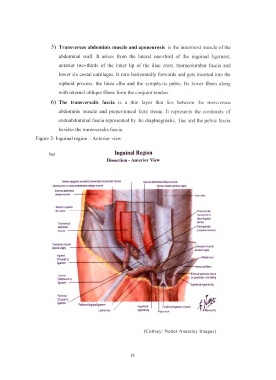
5)  Transversus abdominis  muscle and aponeurosis  is the innermost muscle of the
                          abdominal  wall.  It  arises  from  the  lateral  one-third  of  the  inguinal  ligament,
                          anterior  two-thirds  of the  inner  lip  of the  iliac  crest,  thoracolumbar  fascia  and

                          lower six costal cartilages.  It runs horizontally forwards and gets inserted into the
                          xiphoid  process,  the  linea  alba  and  the  symphysis  pubis.  Its  lower  fibers  along

                          with internal oblique fibers form the conjoint tendon.
                      6)  The  transversalis  fascia  is  a  thin  layer  that  lies  between  the  transversus
                          abdominis  muscle  and  preperitoncal  fatty  tissue.  It  represents  the  continuity  of

                          endoabdominal fascia represented by the diaphragmatic, iliac and the pelvic fascia
                          besides the transversalis fascia.

                Figure 2: Inguinal region - Anterior view

                      ber                        Inguinal Region
                                              Dissection - Anterior View


                           Inferior epigastric vessels (covered bg transversalis fascia)   Internal abdominal oblique muscle
                       Aponeurosis of external abdominal oblique muscle   lectus sheath (anterior layer)
                        External abdominal
                        oblique muscle

                        Anterior superior
                        iliac spine                                                Transversalis
                                                                                   fascia (site of
                                                                                   direct inguinal
                                                                                   hernia)
                         Transversus
                         abdominis                                                 fa lx  inguinaiis
                                                                                   (conformed tendon)
                         muscle  —
                       Cremaster muscle
                                                                                   Remaster muscle
                       (lateral origin)
                                                                                  (medial origin |
                         Inguinal
                                                                                       ial crus
                         (Poupart’s)
                         ligament   ■
                                                                                  Hntercrural fibers
                                                                                 External spermatic fascia
                         Lacunar
                                                                                 on spermatic cord exiting
                         (Gimbernat's
                         ligament  ~
                                                                                    :ial inguinal ring
                         Pectineal
                         (Cooper's)
                         ligament
                                  Reflected inguinal ligament
                                                          Superficial   Fundiform ligament of penis
                                          Lateral crus    inguinal ring              I  ® Novartis
                                                                   Pubic crest
                                                             (Curtsey: Netter Anatomy Images)


                                                       19

