


Page 152 - Demo
P. 152
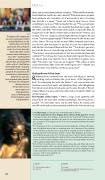
7:36 Throughout this chapter, we see Jesus coming into con ict with the Pharisees, but the relationship is not strictly adversarial: here, a Pharisee invites Jesus to his home for dinner. But when a sinful woman comes and weeps at Jesus’ feet—washing them with her tears, drying them with her hair, anointing them with costly oil—the Pharisee immediately thinks of guilt by association: if Jesus were truly a prophet, he would know the woman was a sinner and not allow her to touch him. Jesus responds with a parable. The more we are forgiven, the more we love. The woman’s actions are an expression of her great love, an act of thanksgiving for the forgiveness God has granted her.
140
LUKE -
them, and anointed them with the ointment. 39When the Pharisee who had invited him saw this he said to himself, “If this man were a prophet, he would know who and what sort of woman this is who is touching him, that she is a sinner.” 40Jesus said to him in reply, “Simon, I have something to say to you.”“Tell me, teacher,”he said. 41“Two people were in debt to a certain creditor; one owed five hundred days’ wages* and the other owed fifty. 42Since they were unable to repay the debt, he forgave it for both. Which of them will love him more?” 43Simon said in reply, “The one, I suppose, whose larger debt was forgiven.” He said to him, “You have judged rightly.” 44Then he turned to the woman and said to Simon, “Do you see this woman? When I entered your house, you did not give me water for my feet, but she has bathed them with her tears and wiped them with her hair. 45You did not give me a kiss, but she has not ceased kissing my feet since the time I entered. 46You did not anoint my head with oil, but she anointed my feet with ointment. 47So I tell you, her many sins have been forgiven; hence, she has shown great love.* But the one to whom little is forgiven, loves little.” 48He said to her, “Your sins are forgiven.”r 49The others at table said to themselves, “Who is this who even forgives sins?”s 50But he said to the woman, “Your faith has saved you; go in peace.”
8Galilean Women Follow Jesus.*
1Afterward he journeyed from one town and village to another, preaching and proclaiming the good news of the kingdom of God.a Accompanying him were the Twelve 2b and some women who had been cured of evil spirits and infirmities, Mary, called Magdalene, from whom seven demons had gone out, 3Joanna, the wife of Herod’s steward Chuza, Susanna, and many others who provided for them out of their resources.
The Parable of the Sower.c 4* When a large crowd gathered, with people from one town after another journeying to him, he spoke in a parable.* 5“A sower went out to sow his seed. And as he sowed, some seed fell on the path and was trampled, and the birds of the sky ate it up.
* [7:41] Days’ wages: one denarius is the normal daily wage of a laborer.
* [7:47] Her many sins have been forgiven; hence, she has shown great love: literally, “her many sins have been forgiven, seeing that she has loved much.” That the woman’s sins have been forgiven is attested by the great love she shows toward Jesus. Her love is the consequence of her forgiveness. This is also the meaning demanded by the parable
in Lk 7:41–43.
* [8:1–3] Luke presents Jesus as an itinerant preacher traveling in the company of the Twelve
and of the Galilean women who are sustaining them out of their means. These Galilean women will later accompany Jesus on his journey to Jerusalem and become witnesses to his death (Lk 23:49) and resurrection (Lk 24:9–11, where Mary Magdalene and Joanna are speci cally mentioned; cf. also Acts 1:14). The association of women with the ministry of Jesus is most unusual in the light of the attitude of rst-century Palestinian Judaism toward women. The more common attitude is expressed in Jn 4:27, and early rabbinic documents caution against speaking with women in public.
* [8:4–21] The focus in this section is on how one should hear the word of God and act on it. It includes the parable of the sower and its explanation (Lk 8:4–15), a collection of sayings on how one should act on the word that is heard (Lk 8:16–18), and the identi cation of the mother and brothers of Jesus as the ones who hear the word and act on it (Lk 8:19–21). See also notes on Mt 13:1–53 and Mk 4:1–34.
* [8:4–8] See note on Mt 13:3–8.
CHAPTER 7
r. [7:48] 5:20; Mt 9:20; Mk 2:5. s. [7:49] 5:21.
CHAPTER 8
a. [8:1] 4:43.
b. [8:2–3] 23:49; 24:10; Mt 27:55–56; Mk 15:40–41; Jn 19:5. c. [8:4–8] Mt 13:1–9; Mk 4:1–9.


