


Page 216 - Demo
P. 216
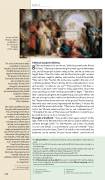
Jesus and the Woman Taken in Adultery, by Giovanni Tiepolo (1727-1804)
8:1 The story of the woman taken in adultery is enclosed in brackets in most translations of the Bible because it does not appear in the earliest texts of the Gospel of John but was inserted at a later date. (It was also inserted into some manuscripts of Luke.) Even though it is the work of a di erent author, the passage has remained part of the Fourth Gospel for centuries and is considered to be a part of the canon of the Scriptures.
The scribes and Pharisees who bring the sinful woman before Jesus are trying to test him, to see how he will interpret the law of Moses. Jesus’ response is extraordinary. Instead of entering into a debate about the law, Jesus responds rst with silence, and then with simple, yet pointed words that turn the eyes of the accusers on themselves. Recognizing their own sinfulness, they walk away, leaving the woman alone with Jesus. “O answer of Wisdom! How He sent them unto themselves! For without they stood to accuse and censure, themselves they examined not inwardly: they saw the adulteress, they looked not into themselves” (St. Augustine).1
1 St. Augustine, Homilies on the Gospel of John, XXXIII, 5.
204
JOHN
8A Woman Caught in Adultery.*
[ Then each went to his own house, 1while Jesus went to the Mount
*a2
of Olives. But early in the morning he arrived again in the temple
area, and all the people started coming to him, and he sat down and taught them. 3Then the scribes and the Pharisees brought a woman who had been caught in adultery and made her stand in the middle. 4They said to him, “Teacher, this woman was caught in the very act of committing adultery. 5Now in the law, Moses commanded us to stone such women.* So what do you say?”b 6They said this to test him, so that they could have some charge to bring against him. Jesus bent down and began to write on the ground with his nger.* 7* But when they continued asking him, he straightened up and said to them,c “Let the one among you who is without sin be the rst to throw a stone at her.” 8Again he bent down and wrote on the ground. 9And in response, they went away one by one, beginning with the elders. So he was left alone with the woman before him. 10Then Jesus straightened up and said to her, “Woman, where are they? Has no one condemned you?”d 11Shereplied,“Noone,sir.”ThenJesussaid,“NeitherdoIcondemnyou. Go, [and] from now on do not sin any more.”]e
The Light of the World.* 12Jesus spoke to them again, saying, “I am the light of the world. Whoever follows me will not walk in darkness, but will have the light of life.”f 13So the Pharisees said to him, “You testify on your own behalf, so your testimony cannot be veri ed.” 14Jesus answered and said to them, “Even if I do testify on my own behalf, my testimony can be veri ed,* because I know where I came from and
* [8:1] Mount of Olives: not mentioned elsewhere in the gospel tradition outside of passion week.
* [8:5] Lv 20:10 and Dt 22:22 mention only death, but Dt 22:23–24 prescribes stoning for a betrothed virgin.
* [8:6] Cf. Jer 17:13 (RSV): “Those who turn away from thee shall be written in the earth, for they have forsaken the LORD, the fountain of living water”; cf. Jn 7:38.
* [8:7] The rst stones were to be thrown by the witnesses (Dt 17:7).
* [8:12–20] Jesus the light of the world. Jesus replaces the four torches of the illumination of
the temple as the light of joy.
* [8:14] My testimony can be veri ed: this seems to contradict Jn 5:31, but the emphasis
here is on Jesus’ origin from the Father and his divine destiny. Where I am going: indicates Jesus’ passion and glori cation.
a. [8:1–2] Lk 21:37–38.
b. [8:5] Lv 20:10; Dt 22:22–29. c. [8:7] Dt 17:7.
d. [8:10] Ez 33:11.
e. [8:11] 5:14.
f. [8:12] 1:4–5, 9; 12:46; Ex 13:22; Is 42:6; Zec 14:8.


