


Page 214 - Demo
P. 214
7:14 During Sukkot, it was customary for pilgrims to gather in the Temple area to listen to the reading of the Torah (the rst ve books of the Bible). In this context, debate reemerges about the healing Jesus performed on the sabbath.
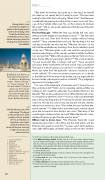
Bethlehem was known as King David’s hometown. In Hebrew, Bethlehem means “house of bread” or ”house of food.” It is located about 2,500 feet above sea level on the main north-south ridge that runs through most of Palestine. This photo shows Bethlehem today.
7:33 “I will be with you only a little while longer.” The Gospel of John records none of the parables of Jesus. Instead, there is an emphasis on mysterious, even cryptic statements like this one, which will become clear only in light of Jesus’ passion and resurrection.
e. [7:13] 9:22; 19:38; 20:19.
f. [7:15] Lk 2:47.
g. [7:17] 6:29.
h. [7:19] Acts 7:53.
i. [7:20] 8:48–49; 10:20.
j. [7:21] 5:1–9.
k. [7:22] Gn 17:10; Lv 12:3.
l. [7:23] 5:2–9, 16; Mt 12:11–12; Lk 14:5.
m. [7:24] 8:15; Lv 19:15; Is 11:3–4.
n. [7:27] Heb 7:3.
o. [7:28] 8:19.
p. [7:29] 6:46; 8:55.
q. [7:30] 7:44; 8:20; Lk 4:29–30.
r. [7:31] 2:11; 10:42; 11:45.
s. [7:33] 13:33; 16:16.
202
JOHN
10But when his brothers had gone up to the feast, he himself also went up, not openly but [as it were] in secret. 11The Jews were looking for him at the feast and saying, “Where is he?” 12And there was considerable murmuring about him in the crowds. Some said, “He is a good man,” [while] others said, “No; on the contrary, he misleads the crowd.” 13Still, no one spoke openly about him because they were afraid of the Jews.e
The First Dialogue.* 14When the feast was already half over, Jesus went up into the temple area and began to teach. 15* f The Jews were amazed and said, “How does he know scripture without having studied?” 16Jesus answered them and said, “My teaching is not my own but is from the one who sent me. 17Whoever chooses to do his will* shall know whether my teaching is from God or whether I speak on my own.g 18Whoever speaks on his own seeks his own glory, but whoever seeks the glory of the one who sent him is truthful, and there is no wrong in him. 19Did not Moses give you the law? Yet none of you keeps the law. Why are you trying to kill me?”h 20The crowd answered, “You are possessed!* Who is trying to kill you?”i 21Jesus answered and said to them, “I performed one work* and all of you are amazedj 22because of it. Moses gave you circumcision—not that it came from Moses but rather from the patriarchs—and you circumcise a man on the sabbath.k 23If a man can receive circumcision on a sabbath so that the law of Moses may not be broken, are you angry with me because I made a whole person well on a sabbath?l 24Stop judging by appearances, but judge justly.”m
25So some of the inhabitants of Jerusalem said, “Is he not the one they are trying to kill? 26And look, he is speaking openly and they say nothing to him. Could the authorities* have realized that he is the Messiah? 27But we know where he is from. When the Messiah comes, no one will know where he is from.”n 28So Jesus cried out in the temple area as he was teaching and said, “You know me and also know where I am from. Yet I did not come on my own, but the one who sent me, whom you do not know, is true.o 29I know him, because I am from him, and he sent me.”p 30So they tried to arrest him, but no one laid a hand upon him, because his hour had not yet come.q 31But many of the crowd began to believe in him, and said, “When the Messiah comes, will he perform more signs than this man has done?”r
O cers Sent to Arrest Jesus.* 32The Pharisees heard the crowd murmuring about him to this e ect, and the chief priests and the Pharisees sent guards to arrest him. 33So Jesus said, “I will be with you only a little while longer, and then I will go to the one who sent me.s
* [7:14–31] Jesus teaches in the temple; debate with the Jews.
* [7:15] Without having studied: literally, “How does he know letters without having
learned?” Children were taught to read and write by means of the scriptures. But here more than Jesus’ literacy is being discussed; the people are wondering how he can teach like a rabbi. Rabbis were trained by other rabbis and traditionally quoted their teachers.
* [7:17] To do his will: presumably a reference back to the “work” of Jn 6:29: belief in the one whom God has sent.
* [7:20] You are possessed: literally, “You have a demon.” The insane were thought to be possessed by a demoniacal spirit.
* [7:21] One work: the cure of the paralytic (Jn 5:1–9) because of the reference to the sabbath (Jn 7:22; 5:9–10).
* [7:26] The authorities: the members of the Sanhedrin (same term as Jn 3:1).
* [7:32–36] Jesus announces his approaching departure (cf. also Jn 8:21; 12:36; 13:33) and
complete control over his destiny.


