


Page 228 - Demo
P. 228
At the beginning of the Gospel of John, John the Baptist pointed Jesus out as the “Lamb of God” (1:29). Now, at the beginning of the “Book of Glory,” the Passion narrative, John points out that Jesus’ “hour” coincides with the Passover, when the blood of the sacri cial lamb marked the houses of the chosen people of God.
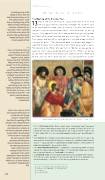
13:3 Jesus is no passive victim of circumstances. He is “fully aware” of what is about to happen to him, and he knows, too, that “the Father had put everything into his power” (13:3). He could have chosen another path: he could have achieved his end through a show of power and strength. Instead, as St. Paul says, “He emptied himself, / taking the form of a slave” (Philippians 2:7). Before submitting to the cross, he kneels and washes the feet of his disciples. For Jesus—and for all who follow him—the path is one of weakness, vulnerability, and servanthood.
John’s is the only one of the four Gospels which does not include the Last Supper account. Instead, John describes the washing of the disciples’ feet. The Eucharist is intimately linked to service: Jesus becomes a servant, so that we may become servants to each other. To participate in the Eucharist is to accept the call to service. “God descends and becomes a slave, he washes our feet so that we may come to his table. In this, the entire mystery of Jesus Christ is expressed. In this, what redemption means becomes visible. The basin in which he washes us is his love, ready to face death” (Pope Benedict XVI).
216
* [13:1–19:42] The Book of Glory. There is a major break here; the word “sign” is used again only in Jn 20:30. In this phase of Jesus’ return to the Father, the discourses (Jn 13–17) precede the traditional narrative of the passion (Jn 18–20) to interpret them for the Christian reader. This is the only extended example of esoteric teaching of disciples in John.
* [13:1–20] Washing of the disciples’ feet. This episode occurs in John at the place of the narration of the institution of the Eucharist in the synoptics. It may be a dramatization of Lk 22:27—“I am your servant.” It is presented as a “model” (“pattern”) of the cruci xion. It symbolizes cleansing from sin by sacri cial death.
* [13:1] Before the feast of Passover: this would be Thursday evening, before the day of preparation; in the synoptics, the Last Supper is a Passover meal taking place, in John’s chronology, on Friday evening. To the end: or, “completely.”
* [13:2] Induced: literally, “The devil put into the heart that Judas should hand him over.”
* [13:5] The act of washing another’s feet was one that could not be required of the
lowliest Jewish slave. It is an allusion to the humiliating death of the cruci xion.
a. [13:1] 2:4; 7:30; 8:20; Mt 26:17, 45; Mk 14:12, 41; Lk 22:7. b. [13:2] 6:71; 17:12; Mt 26:20–21; Mk 14:17–18; Lk 22:3.
c. [13:3] 3:35.
d. [13:5] 1 Sm 25:41.
JOHN
iii. the BooK of glorY*
The Washing of the Disciples’ Feet.*
131Before the feast of Passover,* Jesus knew that his hour had
come to pass from this world to the Father. He loved his own in the world and he loved them to the end.a 2The devil had already induced* Judas, son of Simon the Iscariot, to hand him over. So, during supper,b 3fully aware that the Father had put everything into his power and that he had come from God and was returning to God,c 4he rose from supper and took o his outer garments. He took a towel and tied it around his waist. 5* Then he poured water into a basin and began to wash the disciples’ feetd and dry them with the towel around his waist. 6He came to Simon Peter, who said to him, “Master, are you going to wash my feet?” 7Jesus answered and said to him, “What I am doing, you do not understand now, but you will understand later.” 8Peter said to him, “You will never wash my feet.” Jesus answered him, “Unless
Jesus washes the feet of his disciples, by Giotto (1266-1337)


