


Page 252 - Demo
P. 252
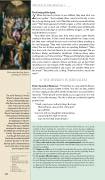
God sends the Holy Spirit, painting by El Greco
2:1 The word “Pentecost” means “ ftieth” in Greek. This Jewish festival, celebrated fty days after Passover, was a harvest- feast. It also came to mark a key event in the history of Israel: the giving of the law on Mount Sinai. Luke’s description of the giving of the Holy Spirit recalls and contrasts with the appearance of God to the people at Mount Sinai: “Mount Sinai was completely enveloped in smoke, because the LORD had come down upon it in re. The smoke rose from it as though from a kiln, and the whole mountain trembled violently” (Exodus 19:18). Here, the Holy Spirit is manifested in a loud sound, like a strong wind, and in tongues of re.
a. [2:1] Lv 23:15–21; Dt 16:9–11.
b. [2:2–3] Jn 3:8.
c. [2:3] Lk 3:16.
d. [2:4] 1:5; 4:31; 8:15, 17; 10:44;
11:15–16; 15:8; 19:6; Ps 104:30;
Jn 20:33.
e. [2:7] 1:11.
f. [2:11] 10:46.
g. [2:13] 1 Cor 14:23.
h. [2:17] Is 2:2; 44:3; Jl 3:1–5.
240
THE ACTS OF THE APOSTLES
2The Coming of the Spirit.
1* When the time for Pentecost was ful lled, they were all in one
a2
place together. And suddenly there came from the sky a noise
like a strong driving wind,* and it lled the entire house in which they were.b 3Then there appeared to them tongues as of re,* which parted and came to rest on each one of them.c 4And they were all lled with the holy Spirit and began to speak in di erent tongues,* as the Spirit enabled them to proclaim.d
5Now there were devout Jews from every nation under heaven staying in Jerusalem. 6At this sound, they gathered in a large crowd, but they were confused because each one heard them speaking in his own language. 7They were astounded, and in amazement they asked, “Are not all these people who are speaking Galileans?e 8Then how does each of us hear them in his own native language? 9We are Parthians, Medes, and Elamites, inhabitants of Mesopotamia, Judea and Cappadocia, Pontus and Asia, 10Phrygia and Pamphylia, Egypt and the districts of Libya near Cyrene, as well as travelers from Rome, 11both Jews and converts to Judaism, Cretans and Arabs, yet we hear them speaking in our own tongues of the mighty acts of God.”f 12They were all astounded and bewildered, and said to one another, “What does this mean?” 13But others said, sco ng, “They have had too much new wine.”g
II. THE MISSION IN JERUSALEM
Peter’s Speech at Pentecost. 14* Then Peter stood up with the Eleven, raised his voice, and proclaimed to them, “You who are Jews, indeed all of you staying in Jerusalem. Let this be known to you, and listen to my words. 15These people are not drunk, as you suppose, for it is only nine o’clock in the morning. 16No, this is what was spoken through the prophet Joel:
17‘It will come to pass in the last days,’ God says, ‘that I will pour out a portion of my spirit upon all esh.
Your sons and your daughters shall prophesy, your young men shall see visions,
your old men shall dream dreams.h
* [2:1–41] Luke’s pentecostal narrative consists of an introduction (Acts 2:1–13), a speech ascribed to Peter declaring the resurrection of Jesus and its messianic signi cance (Acts 2:14–36), and a favorable response from the audience (Acts 2:37–41). It is likely that the narrative telescopes events that took place over a period of time and on a less dramatic scale. The Twelve were not originally in a position to proclaim publicly the messianic o ce of Jesus without incurring immediate reprisal from those religious authorities in Jerusalem who had brought about Jesus’ death precisely to stem the rising tide in his favor.
* [2:2] There came from the sky a noise like a strong driving wind: wind and spirit are associated in Jn 3:8. The sound of a great rush of wind would herald a new action of God in the history of salvation.
* [2:3] Tongues as of re: see Ex 19:18 where re symbolizes the presence of God to initiate the covenant on Sinai. Here the holy Spirit acts upon the apostles, preparing them to proclaim the new covenant with its unique gift of the Spirit (Acts 2:38).
* [2:4] To speak in di erent tongues: ecstatic prayer in praise of God, interpreted in Acts 2:6, 11 as speaking in foreign languages, symbolizing the worldwide mission of the church.
* [2:14–36] The rst of six discourses in Acts (along with Acts 3:12–26; 4:8–12; 5:29–32; 10:34– 43; 13:16–41) dealing with the resurrection of Jesus and its messianic import. Five of these are attributed to Peter, the nal one to Paul. Modern scholars term these discourses in Acts
the “kerygma,” the Greek word for proclamation (cf. 1 Cor 15:11).


