


Page 254 - Demo
P. 254
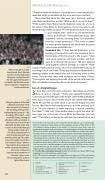
2:38 Peter’s message ends with harsh words: God’s Messiah has been in their midst, and they have cruci ed him. But the message of the Gospel is not death, but life: Peter invites them to baptism—forgiveness and reconciliation.
2:42 We get a glimpse of the ideal Christian community. Their days are spent in listening to the teaching of the apostles, celebrating the Eucharist—“the breaking of the bread”—and in radical charity, sharing all they have with one another so that none are in need. All are lled with the Holy Spirit, who is active in their midst through “many wonders and signs.” This ideal community is not static, but growing, with new members every day. This idyllic vision of the early Church does not endure for long—within a few chapters the community will be scattered. Nevertheless, this vision continues to inspire as each generation of Christians strives to live “the communal life” (2:42) in light of the Gospel.
242
THE ACTS OF THE APOSTLES -
36Therefore let the whole house of Israel know for certain that God has made him both Lord and Messiah, this Jesus whom you cruci ed.”s
37Now when they heard this, they were cut to the heart, and they asked Peter and the other apostles, “What are we to do, my brothers?”t 38Peter [said] to them, “Repent and be baptized,* every one of you, in the name of Jesus Christ for the forgiveness of your sins; and you will receive the gift of the holy Spirit.u 39For the promise is made to you and
to your children and to all those far o , whomever the Lord our God will call.”v 40He testi ed with many other arguments, and was exhorting them, “Save yourselves from this corrupt generation.”w 41Those who accepted his message were baptized, and about three thousand persons were added that day.x
Communal Life.* 42y They devoted themselves to the teaching of the apostles and to the communal life, to the breaking of the bread and to the prayers.z 43Awe came upon everyone, and many wonders and signs were done through the apostles.a 44All who believed were together and had all things in common;b 45they
would sell their property and possessions and divide them among all according to each one’s need. 46Every day they devoted themselves to meeting together in the temple area and to breaking bread in their homes. They ate their meals with exultation and sincerity of heart, 47praising God and enjoying favor with all the people. And every day the Lord added to their number those who were being saved.
3Cure of a Crippled Beggar.
1* Now Peter and John were going up to the temple area for the
* 2a
three o’clock hour of prayer. And a man crippled from birth was
carried and placed at the gate of the temple called “the Beautiful Gate” every day to beg for alms from the people who entered the temple. 3When he saw Peter and John about to go into the temple, he asked for alms. 4But Peter looked intently at him, as did John, and said, “Look at us.” 5He paid attention to them, expecting to receive something from them. 6* Peter said, “I have neither silver nor gold, but what I do have I give you: in the name of Jesus Christ the Nazorean, [rise and] walk.”b 7Then Peter took him by the right hand and raised him up, and
* [3:1–4:31] This section presents a series of related events: the dramatic cure of a lame beggar (Acts 3:1–10) produces a large audience for the kerygmatic discourse of Peter (Acts 3:11–26). The Sadducees, taking exception to the doctrine of resurrection, have Peter, John, and apparently the beggar as well, arrested (Acts 4:1–4) and brought to trial before the Sanhedrin. The issue concerns the authority by which Peter and John publicly teach religious doctrine in the temple (Acts 4:5–7). Peter replies with a brief summary of the kerygma, implying that his authority is prophetic (Acts 4:8–12). The court warns the apostles to abandon their practice of invoking prophetic authority in the name of Jesus (Acts 4:13–18). When Peter and John reply that the prophetic role cannot be abandoned to satisfy human objections, the court nevertheless releases them, afraid to do otherwise since the beggar, lame from birth and over forty years old, is a well-known gure in Jerusalem and the facts of his cure are common property (Acts 4:19–22). The narrative concludes with a prayer of the Christian community imploring divine aid against threats of persecution (Acts 4:23–31).
* [3:1] For the three o’clock hour of prayer: literally, “at the ninth hour of prayer.” With the day beginning at 6 a.m., the ninth hour would be 3 p.m.
* [3:6–10] The miracle has a dramatic cast; it symbolizes the saving power of Christ and leads the beggar to enter the temple, where he hears Peter’s proclamation of salvation through Jesus.
CHAPTER 2
r. [2:34–35] Ps 110:1.
s. [2:36] 9:22; Rom 10:9; Phil 2:11.
t. [2:37] Lk 3:10.
u. [2:38] 3:19; 16:31; Lk 3:3.
v. [2:39] Is 57:19; Jl 3:5; Eph 2:17.
w. [2:40] Dt 32:5; Ps 78:8; Lk 9:41; Phil 2:15.
x. [2:41] 2:47; 4:4; 5:14; 6:7; 11:21, 24; 21:20.
y. [2:42–47] 4:32–35. z. [2:42] 1:14; 6:4.
a. [2:43] 5:12–16.
b. [2:44] 4:32, 34–35. CHAPTER 3
a. [3:2–8] 14:8–10. b. [3:6] 4:10.


