


Page 255 - Demo
P. 255
THE ACTS OF THE APOSTLES
immediately his feet and ankles grew strong. 8He leaped up, stood, and walked around, and went into the temple with them, walking and jumping and praising God.c 9When all the people saw him walking and praising God, 10they recognized him as the one who used to sit begging at the Beautiful Gate of the temple, and they were lled with amazement and astonishment at what had happened to him.
Peter’s Speech. 11As he clung to Peter and John, all the people hurried in amazement toward them in the portico called “Solomon’s Portico.”d 12When Peter saw this, he addressed the people, “You Israelites, why are you amazed at this, and why do you look so intently at us as if we had made him walk by our own power or piety?e 13The God of Abraham, [the God] of Isaac, and [the God] of Jacob, the God of our ancestors, has glori ed* his servant Jesus whom you handed over and denied in Pilate’s presence, when he had decided to release him.f 14You denied the Holy and Righteous One* and asked that a murderer be released to you.g 15* The author of life you put to death, but God raised him from the dead; of this we are witnesses.h 16And by faith in his name,
this man, whom you see and know, his name has made strong,
and the faith that comes through it has given him this perfect
health, in the presence of all of you. 17Now I know, brothers, that
you acted out of ignorance,* just as your leaders did;i 18but God has
thus brought to ful llment what he had announced beforehand
through the mouth of all the prophets,* that his Messiah would
su er.j 19Repent, therefore, and be converted, that your sins may be
wiped away,k 20and that the Lord may grant you times of refreshment
and send you the Messiah already appointed for you, Jesus,* 21whom
heaven must receive until the times of universal restoration* of which
God spoke through the mouth of his holy prophets from of old.
22* For Moses said:
‘A prophet like me will the Lord, your God, raise up for you from among your own kinsmen;
to him you shall listen in all that he may say to you.l 23Everyone who does not listen to that prophet
will be cut o from the people.’m
3:6
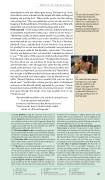
The risen and ascended Christ is still present and active. Through Peter, John, and the others, he is continuing to do what he did when he walked among them: healing, teaching, and drawing all to a deeper relationship with God.
3:12
The same Peter who denied knowing Jesus now boldly preaches salvation in his name, in the gate of the Temple. The eloquence of this uneducated sherman is a clear sign of the presence of the Holy Spirit.
* [3:13] Has glori ed: through the resurrection and ascension of Jesus, God reversed the judgment against him on the occasion of his trial. Servant: the Greek word can also be rendered as “son” or even “child” here and also in Acts 3:26; 4:25 (applied to David); Acts 4:27; and Acts 4:30. Scholars are of the opinion, however, that the original concept re ected in the words identi ed Jesus with the su ering Servant of the Lord of Is 52:13–53:12.
* [3:14] The Holy and Righteous One: so designating Jesus emphasizes his special relationship to the Father (see Lk 1:35; 4:34) and emphasizes his sinlessness and religious dignity that are placed in sharp contrast with the guilt of those who rejected him in favor of Barabbas.
* [3:15] The author of life: other possible translations of the Greek title are “leader of life” or “pioneer of life.” The title clearly points to Jesus as the source and originator of salvation.
* [3:17] Ignorance: a Lucan motif, explaining away the actions not only of the people but also of their leaders in crucifying Jesus. On this basis the presbyters in Acts could continue to appeal to the Jews in Jerusalem to believe in Jesus, even while a rming their involvement in his death because they were unaware of his messianic dignity. See also Acts 13:27 and Lk 23:34.
* [3:18] Through the mouth of all the prophets: Christian pro- phetic insight into the Old Testament saw the cruci xion and death of Jesus as the main import of messianic prophecy. The Jews
themselves did not anticipate a su ering Messiah; they usually understood the Servant Song in Is 52:13–53:12 to signify their own su ering as a people. In his typical fashion (cf. Lk 18:31; 24:25, 27, 44), Luke does not specify the particular Old Testament prophecies that were ful lled by Jesus. See also note on Lk 24:26.
* [3:20] The Lord. . .and send you the Messiah already appointed for you, Jesus: an allusion to the parousia or second coming of Christ, judged to be imminent in the apostolic age. This reference to its nearness is the only explicit one in Acts. Some scholars believe that this verse preserves a very early christology, in which the title “Messiah” (Greek “Christ”) is applied to him as of his parousia, his second coming (contrast Acts 2:36). This view of a future messiahship of Jesus is not found elsewhere in the New Testament.
* [3:21] The times of universal restoration: like “the times of refreshment” (Acts 3:20), an apocalyptic designation of the messianic age, tting in with the christology of Acts 3:20 that associates the messiahship of Jesus with his future coming.
* [3:22] A loose citation of Dt 18:15, which teaches that the Israelites are to learn the will of Yahweh from no one but their prophets. At the time of Jesus, some Jews expected a unique prophet to come in ful llment of this text. Early Christianity applied this tradition and text to Jesus and used them especially in defense of the divergence of Christian teaching from traditional Judaism.
c. [3:8] Is 35:6; Lk 7:22.
d. [3:11] 5:12; Jn 10:23.
e. [3:12] 14:15.
f. [3:13] Ex 3:6, 15; Is 52:13; Lk 23:14–25.
g. [3:14] Mt 27:20–21; Mk 15:11; Lk 23:18; Jn 18:40.
h. [3:15] 4:10; 5:31 / 1:8; 2:32.
i. [3:17] 13:27; Lk 23:34; 1 Cor 2:8; 1 Tm 1:13.
j. [3:18] Lk 18:31.
k. [3:19] 2:38.
l. [3:22] 7:37; Dt 18:15, 18.
m. [3:23] Lv 23:29; Dt 18:19. 243


