


Page 253 - Demo
P. 253
THE ACTS OF THE APOSTLES
18Indeed, upon my servants and my handmaids
I will pour out a portion of my spirit in those days, and they shall prophesy.
19And I will work wonders in the heavens above and signs on the earth below:
blood, re, and a cloud of smoke.
20The sun shall be turned to darkness,
and the moon to blood,
before the coming of the great and splendid day of the Lord,
21and it shall be that everyone shall be saved who calls on the name of the Lord.’i
22You who are Israelites, hear these words. Jesus the Nazorean was a man commended to you by God with mighty deeds, wonders, and signs, which God worked through him in your midst, as you yourselves know.j 23This man, delivered up by the set plan and foreknowledge of God, you killed, using lawless men to crucify him.k 24But God raised him up, releasing him from the throes of death, because it was impossible for him to be held by it.l 25For David says of him:
‘I saw the Lord ever before me,m
with him at my right hand I shall not be disturbed.
26Therefore my heart has been glad and my tongue has exulted; my esh, too, will dwell in hope,
27because you will not abandon my soul to the netherworld, nor will you su er your holy one to see corruption.n
28You have made known to me the paths of life; you will ll me with joy in your presence.’
29My brothers, one can con dently say to you about the patriarch David that he died and was buried, and his tomb is in our midst to this day. 30But since he was a prophet and knew that God had sworn an oath to him that he would set one of his descendants upon his throne,o 31he foresaw and spoke of the resurrection of the Messiah, that neither was he abandoned to the netherworld nor did his esh see corruption.p 32God raised this Jesus; of this we are all witnesses. 33Exalted at the right hand of God,* he received the promise of the holy Spirit from the Father and poured it forth, as you [both] see and hear.q 34For David did not go up into heaven, but he himself said:
‘The Lord said to my Lord, “Sit at my right handr
35until I make your enemies your footstool.”’
2:11
The Pentecost event is a miracle of understanding. The disciples are given the gift of speech, to be able to proclaim the deeds of God aloud, but every person present is touched by the Spirit and is able to understand the teaching of the disciples in their own language. Pentecost reverses what happened at Babel, when God punished the arrogance of human beings
by confusing their languages so that they could no longer understand one another (Genesis 11).
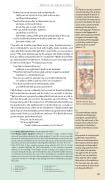
David with his harp, from an old manuscript
2:9
This extraordinary catalog of peoples and languages anticipates a major theme in Acts: the wide reach of the Gospel, which spreads from Jerusalem to the farthest reaches of the known world.
2:14
Peter speaks to Jewish people gathered in Jerusalem for Pentecost, and in preaching the Gospel to them he draws extensively on the prophets (with a long quotation from Joel 3) and on the psalms. Throughout the Acts of the Apostles, we see how Peter, Paul, and the others adapt themselves to their audience. The message stays the same, but the means of delivering it can be quite di erent.
241
* [2:33] At the right hand of God: or “by the right hand of God.”
* [2:38] Repent and be baptized: repentance is a positive concept, a change of mind
and heart toward God re ected in the actual goodness of one’s life. It is in accord with the apostolic teaching derived from Jesus (Acts 2:42) and ultimately recorded in the four gospels. Luke presents baptism in Acts as the expected response to the apostolic preaching about Jesus and associates it with the conferring of the Spirit (Acts 1:5; 10:44–48; 11:16).
* [2:42–47] The rst of three summary passages (along with Acts 4:32–37; 5:12–16) that outline, somewhat idyllically, the chief characteristics of the Jerusalem community: adherence to the teachings of the Twelve and the centering of its religious life in the eucharistic liturgy (Acts 2:42); a system of distribution of goods that led wealthier Christians to sell their possessions when the needs of the community’s poor required it (Acts 2:44 and the note on Acts 4:32–37); and continued attendance at the temple, since in this initial stage there was little or no thought of any dividing line between Christianity and Judaism (Acts 2:46).
i. [2:21] Rom 10:13.
j. [2:22] 10:38; Lk 24:19.
k. [2:23] 1 Thes 2:15. l. [2:24] 13:34.
m.[2:25–28] Ps 16:8–11.
n. [2:27] 13:35.
o. [2:30] 2 Sm 7:12; Ps 132:11.
p. [2:31] 13:35; Ps 16:10.q. [2:33] 1:4–5.


