


Page 261 - Demo
P. 261
THE ACTS OF THE APOSTLES -
words against Moses and God.”e 12They stirred up the people, the elders, and the scribes, accosted him, seized him, and brought him
13 *
before the Sanhedrin. They presented false witnesses who testi ed,
“This man never stops saying things against [this] holy place and the law. 14For we have heard him claim that this Jesus the Nazorean will destroy this place and change the customs that Moses handed down to us.”f 15All those who sat in the Sanhedrin looked intently at him and saw that his face was like the face of an angel.
7Stephen’s Discourses.
1Then the high priest asked, “Is this so?” 2a And he replied,* “My brothers and fathers, listen. The God of glory appeared to our father
Abraham while he was in Mesopotamia,* before he had settled in Haran, 3and said to him, ‘Go forth from your land and [from] your kinsfolk to the land that I will show you.’b 4So he went forth from the land of the Chaldeans and settled in Haran. And from there, after his father died, he made him migrate to this land where you now dwell.c 5Yet he gave him no inheritance in it, not even a foot’s length, but he did promise to give it to him and his descendants as a possession, even though he was childless.d 6And God spoke thus,e ‘His descendants shall be aliens in a land not their own, where they shall be enslaved and oppressed for four hundred years; 7but I will bring judgment on the nation they serve,’ God said, ‘and after that they will come out and worship me in this place.’f 8Then he gave him the covenant of circumcision, and so he became the father of Isaac, and circumcised him on the eighth day, as Isaac did Jacob, and Jacob the twelve patriarchs.g
9“And the patriarchs, jealous of Joseph, sold him into slavery in Egypt; but God was with himh 10and rescued him from all his a ictions. He granted him favor and wisdom before Pharaoh, the king of Egypt, who put him in charge of Egypt and [of ] his entire household.i 11Then a famine and great a iction struck all Egypt and Canaan, and our ancestors could nd no food;j 12but when Jacob heard that there was grain in Egypt, he sent our ancestors there a rst time.k 13The second time, Joseph made himself known to his brothers, and Joseph’s family became known to Pharaoh.l 14Then Joseph sent for his father Jacob, inviting him and his whole clan, seventy- ve persons;m 15and Jacob went down to Egypt. And he and our ancestors diedn 16and were brought back to Shechem and placed in the tomb that Abraham had
7:1
Stephen does not seek to defend himself from the charges brought against him. Instead, he seeks to convert his accusers. He begins with the respectful address, “my brothers and fathers,” acknowledging his peers and his elders.
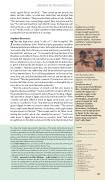
The illustration above represents an Egyptian dignitary on a war chariot in battle.
Joseph was one of
the sons of Jacob and Rachel; thus, Abraham’s grandson. At this time Egypt was a powerful country to the southwest of Canaan.
For Stephen, Joseph’s life was an example for early Christians to follow. Although rejected by
his brothers, God helped
him to reach a high position in Egypt. In the same way Jesus went through suffering before being raised up to God’s right hand.
CHAPTER 6
e. [6:11] Mt 26:59–61; Mk 14:55–58; Acts 21:21.
f. [6:14] Mt 26:59–61; 27:40; Jn 2:19.
CHAPTER 7
a. [7:2] Gn 11:31; 12:1; Ps 29:3.
b. [7:3] Gn 12:1.
c. [7:4] Gn 12:5; 15:7.
d. [7:5] Gn 12:7; 13:15; 15:2; 16:1; Dt 2:5.
e. [7:6–7] Gn 15:13–14.
f. [7:7] Ex 3:12.
g. [7:8] Gn 17:10–14; 21:2–4.
h. [7:9] Gn 37:11, 28; 39:2, 3, 21, 23.
i. [7:10] Gn 41:37–43; Ps 105:21;
Wis 10:13–14.
j. [7:11] Gn 41:54–57; 42:5.
k. [7:12] Gn 42:1–2.
l. [7:13] Gn 45:3–4, 16.
m. [7:14] Gn 45:9–11, 18–19; 46:27;
Ex 1:5 LXX; Dt 10:22.
n. [7:15] Gn 46:5–6; 49:33.
249
The charges that Stephen depreciated the importance of the temple and the Mosaic law and elevated Jesus to a stature above Moses (Acts 6:13–14) were in fact true. Before the Sanhedrin, no defense against them was possible. With Stephen, who thus perceived the fuller implications of the teachings of Jesus, the di erences between Judaism and Christianity began to appear. Luke’s account of Stephen’s martyrdom and its aftermath shows how the major impetus behind the Christian movement passed from Jerusalem, where the temple and law prevailed, to Antioch in Syria, where these in uences were less pressing.
* [6:13] False witnesses: here, and in his account of Stephen’s execution (Acts 7:54–60), Luke parallels the martyrdom of Stephen with the death of Jesus.
* [7:2–53] Stephen’s speech represents Luke’s description of Christianity’s break from its Jewish matrix. Two motifs become prominent in the speech: (1) Israel’s reaction to God’s chosen leaders in the past reveals that the people have consistently rejected them; and (2) Israel has misunderstood God’s choice of the Jerusalem temple as the place where he is to be worshiped.
* [7:2] God. . .appeared to our father Abraham. . .in Mesopotamia: the rst of a number of minor discrepancies between the data of the Old Testament and the data of Stephen’s discourse. According to Gn 12:1, God rst spoke to Abraham in Haran. The main discrepancies are these: in Acts 7:16 it is said that Jacob was buried in Shechem, whereas Gn 50:13 says he was buried at Hebron; in the same verse it is said that the tomb was purchased by Abraham, but in Gn 33:19 and Jos 24:32 the purchase is attributed to Jacob himself.


