


Page 260 - Demo
P. 260
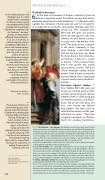
6:1 As the community grows, new challenges arise. It is still an entirely Jewish community, but they are a diverse group, some speaking Greek, others speaking Hebrew or Aramaic,
and there are complaints that the “Hellenists,” the Greek- speakers, are being treated di erently from the Hebrews. It is a crisis in leadership, to which the apostles respond promptly and e ectively, in a process that combines prayer, discernment, and common sense. The result is a division of labor: the apostles dedicate themselves to prayer and preaching, while others, later called deacons, are chosen for a new ministry of service, to “serve at table” (6:2), that is, to care for the needs of the community. Notice how the entire community of believers participates in the selection of these new ministers.
Painting by Rubens (1577-1640)
6:6 The laying on of hands is an ancient ritual gesture, which appears in the Old Testament: it signi es the conferring both of responsibility and of God’s blessing. The laying on of hands continues to be an important element in many aspects of the Church’s
liturgy, especially in the celebration of the sacraments. It signi es the giving of the Holy Spirit in the sacraments of Con rmation and Holy Orders, and it is a sign of God’s blessing in the sacraments of healing: Penance and the Anointing of the Sick.
a. [6:1] 2:45; 4:34–35.
b. [6:6] 1:24; 13:3; 14:23.
c. [6:7] 9:31; 12:24; 16:5; 19:20; 28:30–31. d. [6:10] Lk 21:15.
248
THE ACTS OF THE APOSTLES
6The Need for Assistants.
1* At that time, as the number of disciples continued to grow, the Hellenists complained against the Hebrews because their widows were being neglected in the daily distribution.a 2* So the Twelve called together the community of the disciples and said, “It is not right for us to neglect the word of God to serve at table.* 3Brothers, select from
among you seven reputable men, lled with the Spirit and wisdom, whom we shall appoint to this task, 4whereas we shall devote ourselves to prayer and to the ministry of the word.” 5The proposal was acceptable to the whole community, so they chose Stephen, a man lled with faith and the holy Spirit, also Philip, Prochorus, Nicanor, Timon, Parmenas, and Nicholas of Antioch, a convert to Judaism. 6b They presented these men to the apostles who prayed and laid hands on them.* 7The word of God continued to spread, and the number of the disciples in Jerusalem increased greatly; even a large group of priests were becoming obedient to the faith.c
Accusation Against Stephen. 8* Now Stephen, lled with grace and power, was working great wonders and signs among the people. 9Certain members of the so-called Synagogue of Freedmen, Cyrenians, and Alexan- drians, and people from Cilicia and Asia, came forward and debated with Stephen, 10but they could not withstand the wisdom and the spirit with which he spoke.d 11Then they instigated some men to say, “We have heard him speaking blasphemous
* [6:1–7] The Hellenists. . .the Hebrews: the Hellenists were not necessarily Jews from the diaspora, but were more probably Palestinian Jews who spoke only Greek. The Hebrews were Palestinian Jews who spoke Hebrew or Aramaic and who may also have spoken Greek. Both groups belong to the Jerusalem Jewish Christian community. The con ict between them leads to a restructuring of the community that will better serve the community’s needs. The real purpose of the whole episode, however, is to introduce Stephen as a prominent gure in the community whose long speech and martyrdom will be recounted in Acts 7.
* [6:2–4] The essential function of the Twelve is the “service of the word,” including development of the kerygma by formulation of the teachings of Jesus.
* [6:2] To serve at table: some commentators think that it is not the serving of food that is described here but rather the keeping of the accounts that recorded the distribution of food to the needy members of the community. In any case, after Stephen and the others are chosen, they are never presented carrying out the task for which they were appointed (Acts 6:2–3). Rather, two of their number, Stephen and Philip, are presented as preachers of the Christian message. They, the Hellenist counterpart of the Twelve, are active in the ministry of the word.
* [6:6] They. . .laid hands on them: the customary Jewish way of designating persons for a task and invoking upon them the divine blessing and power to perform it.
* [6:8–8:1] The summary (Acts 6:7) on the progress of the Jerusalem community, illustrated by the conversion of the priests, is followed by a lengthy narrative regarding Stephen. Stephen’s defense is not a response to the charges made against him but takes the form of a discourse that reviews the fortunes of God’s word to Israel and leads to a prophetic declaration: a plea for the hearing of that word as announced by Christ and now possessed by the Christian community.


