


Page 28 - Demo
P. 28
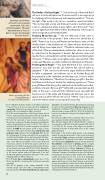
Salt brings out the avor of food; it is also a natural preservative. Salt is also symbol of wisdom. The word translated here as “loses its avor” can also be translated “becomes foolish.”
Moses receiving the Ten Commandments, by Joos van Wassenhove
MATTHEW
The Similes of Salt and Light.* 13i “You are the salt of the earth. But if salt loses its taste, with what can it be seasoned? It is no longer good for anything but to be thrown out and trampled underfoot.* 14You are the light of the world. A city set on a mountain cannot be hidden.j 15Nor do they light a lamp and then put it under a bushel basket; it is set on a lampstand, where it gives light to all in the house.k 16Just so, your light must shine before others, that they may see your good deeds and glorify your heavenly Father.l
Teaching About the Law. 17* “Do not think that I have come to abolish the law or the prophets. I have come not to abolish but to fulfill. 18Amen, I say to you, until heaven and earth pass away, not the smallest letter or the smallest part of a letter will pass from the law, until all things have taken place.m 19Therefore, whoever breaks one of the least of these commandments and teaches others to do so will be called least in the kingdom of heaven. But whoever obeys and teaches these commandments will be called greatest in the kingdom of heaven.* 20I tell you, unless your righteousness surpasses that of the scribes and Pharisees, you will not enter into the kingdom of heaven. Teaching About Anger.* 21“You have heard that it was said to your ancestors,n ‘You shall not kill; and whoever kills will be liable to judgment.’* 22* But I say to you, whoever is angry* with his brother will be liable to judgment,o and whoever says to his brother, ‘Raqa,’ will be answerable to the Sanhedrin, and whoever says, ‘You fool,’ will be liable to fiery Gehenna. 23Therefore, if you bring your gift to the altar, and there recall that your brother has anything against you,p 24leave your gift there at the altar, go first and be reconciled with your brother, and then come and offer your gift. 25Settle with your opponent quickly while on the way to court with him.q Otherwise your opponent will hand you over to the judge, and the judge will hand you over to the guard, and you will be thrown into prison. 26Amen, I say to you, you will not be released until you have paid the last penny.
* [5:13–16] By their deeds the disciples are to in uence the world for good. They can no more escape notice than a city set on a mountain. If they fail in good works, they are as useless as avorless salt or as a lamp whose light is concealed.
* [5:13] The unusual supposition of salt losing its avor has led some to suppose that the saying refers to the salt of the Dead Sea that, because chemically impure, could lose its taste.
* [5:17–20] This statement of Jesus’ position concerning the Mosaic law is composed of traditional material from Matthew’s sermon documentation (see note on Mt 5:1–7:29), other Q material (cf. Mt 18; Lk 16:17), and the evangelist’s own editorial touches. To ful ll the law appears at rst to mean a literal enforcement of the law in the least detail: until heaven and earth pass away nothing of the law will pass (Mt 5:18). Yet the “passing away” of heaven and earth is not necessarily the end of the world understood, as in much apocalyptic literature, as the dissolution of the existing universe. The “turning of the ages” comes with the apocalyptic event of Jesus’ death and resurrection, and those to whom this gospel is addressed are living in the new and nal age, prophesied by Isaiah as the time of “new heavens and a new earth” (Is 65:17; 66:22). Meanwhile, during Jesus’ ministry when the kingdom is already breaking in, his mission remains within the framework of the law, though with signi cant anticipation of the age to come, as the following antitheses (Mt 5:21–48) show.
* [5:19] Probably these commandments means those of the Mosaic law. But this is an interim ethic “until heaven and earth pass away.”
*[5:21–48] Six examples of the conduct demanded of the Christian disciple. Each deals with a commandment of the law, introduced by You have heard that it was said to your
16
* *
*
ancestors or an equivalent formula, followed by Jesus’ teaching in respect to that commandment, But I say to you; thus their designation as “antitheses.” Three of them accept the Mosaic law but extend or deepen it (Mt 5:21–22; 27–28; 43–44); three reject it as a standard of conduct for the disciples (Mt 5:31–32; 33–37; 38–39).
[5:21] Cf. Ex 20:13; Dt 5:17. The second part of the verse is not an exact quotation from the Old Testament, but cf. Ex 21:12. [5:22–26] Reconciliation with an o ended brother is urged in the admonition of Mt 5:23–24 and the parable of Mt 5:25–26 (// Lk 12:58–59). The severity of the judge in the parable is a warning of the fate of unrepentant sinners in the coming judgment by God.
[5:22] Anger is the motive behind murder, as the insulting epithets are steps that may lead to it. They, as well as the deed, are all forbidden. Raqa: an Aramaic word rēqā’ or rēqâ probably meaning “imbecile,”“blockhead,” a term of abuse. The ascending order of punishment, judgment (by a local council?), trial before the Sanhedrin, condemnation to Gehenna, points to a higher degree of seriousness in each of the o enses. Sanhedrin: the highest judicial body of Judaism. Gehenna: in Hebrew gê- hinnōm, “Valley of Hinnom,” or gê ben-hinnōm, “Valley of the son of Hinnom,” southwest of Jerusalem, the center of an idolatrous cult during the monarchy in which children were o ered in sacri ce (see 2 Kgs 23:10; Jer 7:31). In Jos 18:16 (Septuagint, Codex Vaticanus) the Hebrew is transliterated into Greek as gaienna, which appears in the New Testament as geenna. The concept of punishment of sinners by re either after death or after the nal judgment is found in Jewish apocalyptic literature (e.g., Enoch 90:26) but the name geenna is rst given to the place of punishment in the New Testament.


