


Page 32 - Demo
P. 32
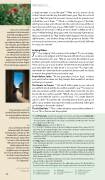
7:3 Jesus uses a memorable metaphor to drive home his point about judging others. How can we see to remove a splinter from someone else’s eye, when we have a log in our own? And yet, we attempt this impossible task every time we judge those around us while remaining blind to our own sins. We ourselves will decide the measure by which God will judge us, for God will “forgive us our trespasses as we forgive those who trespass against us.”
7:6 Dogs and pigs were both considered unclean animals in the Jewish tradition. We need to keep what is holy, holy.
7:12 Jesus summarizes the Old Testament with this simple teaching that is known as “the Golden Rule”: we must treat others the way we want others to treat us. Our relationship with God is bound up in our relationships with those around us. “He who loves his neighbor must consequently love Love itself above all things; but God is Love; therefore he loves God above all things” (St. Augustine).1
20
1 De Trin., viii, 7.
MATTHEW -
a single moment to your life-span?* 28Why are you anxious about clothes? Learn from the way the wild flowers grow. They do not work or spin. 29But I tell you that not even Solomon in all his splendor was clothed like one of them. 30* If God so clothes the grass of the field, which grows today and is thrown into the oven tomorrow, will he not much more provide for you, O you of little faith? 31So do not worry and say, ‘What are we to eat?’ or ‘What are we to drink?’ or ‘What are we to wear?’ 32All these things the pagans seek. Your heavenly Father knows that you need them all. 33But seek first the kingdom [of God] and his righteousness,* and all these things will be given you besides. 34Do not worry about tomorrow; tomorrow will take care of itself. Sufficient for a day is its own evil.
7Judging Others.
1* a “Stop judging,* that you may not be judged.b 2For as you judge, so will you be judged, and the measure with which you measure
will be measured out to you.c 3Why do you notice the splinter in your brother’s eye, but do not perceive the wooden beam in your own eye? 4How can you say to your brother, ‘Let me remove that splinter from your eye,’ while the wooden beam is in your eye? 5You hypocrite,* remove the wooden beam from your eye first; then you will see clearly to remove the splinter from your brother’s eye.
Pearls Before Swine. 6“Do not give what is holy to dogs,* or throw your pearls before swine, lest they trample them underfoot, and turn and tear you to pieces.d
The Answer to Prayers. 7e “Ask and it will be given to you; seek and you will find; knock and the door will be opened to you.f 8For everyone who asks, receives; and the one who seeks, finds; and to the one who knocks, the door will be opened.g 9Which one of you would hand his son a stone when he asks for a loaf of bread,* 10or a snake when he asks for a fish? 11If you then, who are wicked, know how to give good gifts to your children, how much more will your heavenly Father give good things to those who ask him.h
The Golden Rule. 12* “Do to others whatever you would have them do to you.i This is the law and the prophets.
* [6:30] Of little faith: except for the parallel in Lk 12:28, the word translated of little faith is found in the New Testament only in Matthew. It is used by him of those who are disciples of Jesus but whose faith in him is not as deep as it should be (see Mt 8:26; 14:31; 16:8 and the cognate noun in Mt 17:20).
* [6:33] Righteousness: see note on Mt 3:14–15.
* [7:1–12] In Mt 7:1 Matthew returns to the basic traditional material of the sermon (Lk 6:37–
38, 41–42). The governing thought is the correspondence between conduct toward one’s
fellows and God’s conduct toward the one so acting.
* [7:1] This is not a prohibition against recognizing the faults of others, which would be hardly
compatible with Mt 7:5, 6 but against passing judgment in a spirit of arrogance, forgetful
of one’s own faults.
* [7:5] Hypocrite: the designation previously given to the scribes and Pharisees is here given
to the Christian disciple who is concerned with the faults of another and ignores his own
more serious o enses.
* [7:6] Dogs and swine were Jewish terms of contempt for Gentiles. This saying may originally
have derived from a Jewish Christian community opposed to preaching the gospel (what is holy, pearls) to Gentiles. In the light of Mt 28:19 that can hardly be Matthew’s meaning. He may have taken the saying as applying to a Christian dealing with an obstinately impenitent fellow Christian (Mt 18:17).
* [7:9–10] There is a resemblance between a stone and a round loaf of bread and between a serpent and the scaleless sh called barbut.
* [7:12] See Lk 6:31. This saying, known since the eighteenth century as the “Golden Rule,” is found in both positive and negative form in pagan and Jewish sources, both earlier and
a. [7:1–5] Lk 6:37–38, 41–42.
b. [7:1] Rom 2:1–2; 1 Cor 4:5.
c. [7:2] Wis 12:22; Mk 4:24.
d. [7:6] Prv 23:9.
e. [7:7–11] Mk 11:24; Lk 11:9–13. f. [7:7] 1x8:19.
g. [7:8] Lk 18:1–8; Jn 14:13. h. [7:11] 1 Jn 5:14–15.
i. [7:12] Lk 6:31.


