


Page 34 - Demo
P. 34
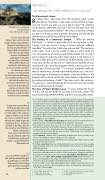
Remains of a synagogue in Capernaum from the fourth century
In Jesus’ time, the term “leprosy” was used to describe a wide variety of skin ailments. The person with leprosy was not only avoided because of the possibility of contagion; he or she was also ritually unclean, not allowed to participate in the public worship of the community. These su erers had to live outside the settlement and to cry out “unclean, unclean” as a warning to others (Leviticus 13). Anyone who touched someone with leprosy was rendered unclean as well, a fact which makes Jesus’ encounter with the this man even more astonishing. He reaches out, touches him, heals him, and sends him to the priests so that he can be restored to the community.
8:5 A centurion was an o cer in the Roman army who could command anywhere from 100 to 1,000 soldiers. The centurion protests that he is not worthy for Jesus to come to his house, but asks him simply to give the command. Jesus is amazed at his faith. In the Mass, we echo the centurion’s act of faith just before Communion: “Lord, I am not worthy that you should enter under my roof, but only say the word and my soul shall be healed” (Roman Missal).
8:14 Jesus heals Peter’s mother-in- law, and she immediately gets up and begins to serve him. We respond to God’s freely given grace by serving God and one another.
22
MATTHEW
III. MINISTRY AND MISSION IN GALILEE* 8The Cleansing of a Leper.
1a When Jesus came down from the mountain, great crowds 2*
followed him. And then a leper approached, did him homage, and said, “Lord, if you wish, you can make me clean.” 3He stretched out his hand, touched him, and said, “I will do it. Be made clean.” His leprosy was cleansed immediately. 4* Then Jesus said to him, “See that you tell no one, but go show yourself to the priest, and offer the gift that Moses prescribed;b that will be proof for them.”
The Healing of a Centurion’s Servant.* 5c When he entered Capernaum,* a centurion approached him and appealed to him, 6saying, “Lord, my servant is lying at home paralyzed, suffering dreadfully.” 7He said to him, “I will come and cure him.” 8The centurion said in reply,* “Lord, I am not worthy to have you enter under my roof; only say the word and my servant will be healed. 9For I too am a person subject to authority, with soldiers subject to me. And I say to one, ‘Go,’ and he goes; and to another, ‘Come here,’ and he comes; and to my slave, ‘Do this,’ and he does it.” 10When Jesus heard this, he was amazed and said to those following him, “Amen, I say to you, in no one in Israel* have I found such faith. 11d I say to you,* many will come from the east and the west, and will recline with Abraham, Isaac, and Jacob at the banquet in the kingdom of heaven, 12but the children of the kingdom will be driven out into the outer darkness, where there will be wailing and grinding of teeth.” 13And Jesus said to the centurion, “You may go; as you have believed, let it be done for you.” And at that very hour [his] servant was healed.
The Cure of Peter’s Mother-in-Law.* 14e Jesus entered the house of Peter, and saw his mother-in-law lying in bed with a fever. 15He touched her hand, the fever left her, and she rose and waited on him.f
* [8:1–9:38] This narrative section of the second book of the gospel is composed of nine miracle stories, most of which are found in Mark, although Matthew does not follow the Marcan order and abbreviates the stories radically. The stories are arranged in three groups of three, each group followed by a section composed principally of sayings of Jesus about discipleship. Mt 9:35 is an almost verbatim repetition of Mt 4:23. Each speaks of Jesus’ teaching, preaching, and healing. The teaching and preaching form the content of Mt 5–7; the healing, that of Mt 8–9. Some scholars speak of a portrayal of Jesus as “Messiah of the Word” in Mt 5–7 and “Messiah of the Deed” in Mt 8–9. That is accurate so far as it goes, but there is also a strong emphasis on discipleship in Mt 8–9; these chapters have not only christological but ecclesiological import.
* [8:2] A leper: see note on Mk 1:40.
* [8:4] Cf. Lv 14:2–9. That will be proof for them: the Greek can also mean “that will be proof
against them.” It is not clear whether them refers to the priests or the people.
* [8:5–13] This story comes from Q (see Lk 7:1–10) and is also re ected in Jn 4:46–54. The similarity between the Q story and the Johannine is due to a common oral tradition, not to a common literary source. As in the later story of the daughter of the Canaanite woman (Mt 15:21–28) Jesus here breaks with his usual procedure of ministering only to Israelites and
anticipates the mission to the Gentiles.
* [8:5] A centurion: a military o cer commanding a hundred men. He was probably in the
service of Herod Antipas, tetrarch of Galilee; see note on Mt 14:1.
* [8:8–9] Acquainted by his position with the force of a command, the centurion expresses faith
in the power of Jesus’ mere word.
* [8:10] In no one in Israel: there is good textual attestation (e.g., Codex Sinaiticus) for a reading
identical with that of Lk 7:9, “not even in Israel.” But that seems to be due to a harmonization
of Matthew with Luke.
* [8:11–12] Matthew inserts into the story a Q saying (see Lk 13:28–29) about the entrance of
Gentiles into the kingdom and the exclusion of those Israelites who, though descended from the patriarchs and members of the chosen nation (the children of the kingdom), refused to believe in Jesus. There will be wailing and grinding of teeth: the rst occurrence of a phrase used frequently in this gospel to describe nal condemnation (Mt 13:42, 50; 22:13; 24:51; 25:30). It is found elsewhere in the New Testament only in Lk 13:28.
* [8:14–15] Cf. Mk 1:29–31. Unlike Mark, Matthew has no implied request by others for the woman’s cure. Jesus acts on his own initiative, and the cured woman rises and waits not on “them” (Mk 1:31) but on him.
a. [8:1–4] Mk 1:40–44; Lk 5:12–14.
b. [8:4] Lv 14:2–32; Lk 17:14.
c. [8:5–13] Lk 7:1–10; Jn 4:46–53.
d. [8:11–12] 13:42, 50; 22:13; 24:51; 25:30; Lk 13:28–29. e. [8:14–16] Mk 1:29–34; Lk 4:38–41.
f. [8:15] 9:25.


